The 6 Best Blackout Sensory Tents for Autism & Meltdown Decompression: An OT & Architect Guide
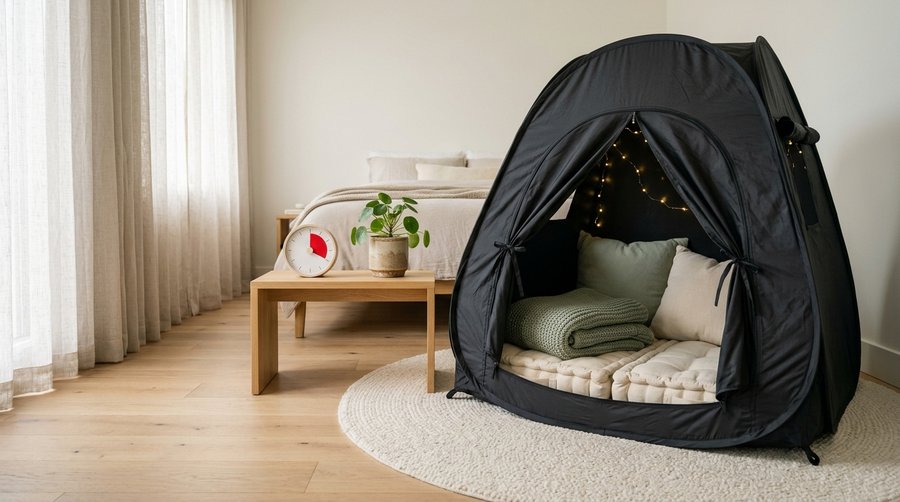
When visual overload triggers acute fight-or-flight, standard calm down corners fail. An architect dad reviews the 6 best blackout sensory tents, pods, and bed canopies for light blocking, mesh ventilation, and meltdown safety.
Editorial Disclosure & Medical Scope: Sensory Kids Books shares neurodiversity-affirming, lived-experience insights and sensory-informed tools for parents, caregivers, and educators. This publication is for educational purposes only and does not constitute formal medical diagnosis, psychiatric evaluation, or clinical occupational therapy advice. Always consult a qualified pediatrician or licensed clinician for individual medical care. As an Amazon Associate, we earn from qualifying purchases through our independent affiliate links at zero extra cost to you.
It happens in the span of three minutes. Your child walked in the front door from an exhausting school day, endured the fluorescent glare of the kitchen, heard the blender whirl and the dog bark, and their entire nervous system abruptly overloaded. The tears start, followed by screams, curled fists, kicking walls, or retreating under a dining chair with hands clamped desperately over their ears.
As parents and educators, our instinctive reaction is often to offer verbal reassurance: "You're okay, take deep breaths, look at me." But to a brain in acute sensory overload, your voice is not soothing—it is just another blast of decibels crashing into a fried sensory gateway. The visual environment is just as punishing: 4,000-lumen overhead LEDs, blinking appliance lights, and visual clutter continue firing the amygdala's threat alarms.
This is where a blackout sensory tent becomes a game-changer. As a sensory architect and father who has spent over a decade analyzing how interior volumes, photon distribution, and tactile boundaries regulate the human nervous system, I view a blackout sensory pod not as a "toy," but as critical neurological shelter. It is an intentional micro-architectural envelope designed to strip away 99% of environmental noise, allowing an overstimulated brain to shift out of sympathetic fight-or-flight and back into parasympathetic equilibrium.
In architectural acoustic and optical design, we design "clean rooms" to eliminate dust and vibration. In sensory parenting, a blackout tent is a visual and cognitive clean room. By cutting ambient light from 350–500 lux down to under 5 lux, you reduce ocular processing load by over 90%, freeing precious neural bandwidth for somatic co-regulation.
Why Standard Calm Down Corners Fail (And Why Blackout Tents Work)
Most families start their regulation journey by building an open calm-down corner in the living room or bedroom. They buy a bean bag, throw a couple of pillows on the floor, and stick a feelings chart on the wall. Yet, when an intense sensory meltdown hits, the child runs right past it or throws the pillows across the room.
Why? Because an open corner has no spatial perimeter. It does not block visual glare, peripheral motion, or ambient noise. The child's retinas are still tracking shadows, siblings walking past, and flashing television screens. For a child with Sensory Processing Sensitivity (SPS), Autism Spectrum Disorder (ASD), or ADHD, open corners lack the proprioceptive containment and visual darkness necessary to signal somatic safety.
A dedicated blackout sensory tent solves three architectural flaws inherent in open calm-down corners:
1. Photonic Isolation: High-density multi-ply blackout fabrics (such as 300D silver-lined Oxford) block up to 99% of external photons. The optic nerve rests, halting the constant micro-saccades that overstimulate the visual cortex.
2. Boundary Containment (Proprioceptive Certainty): An enclosed pod provides a tactile boundary. When a child curls up against the fabric wall, their body maps its physical edges, dampening vestibular disorientation and gravitational insecurity.
3. Acoustic Diffusion: While fabric tents are not soundproof sound booths, their multi-layered soft walls reduce indoor flutter echo and room reverberation by 4–6 decibels, turning harsh sharp noises into muted, tolerable thuds.
How We Evaluated the Top Blackout Tents: The 5-Point OT & Architect Scorecard
Not all children's play tents qualify as therapeutic sensory pods. Flimsy nylon playhouses with cartoon characters often have thin fabrics that let 60% of room light shine right through, flimsy plastic poles that snap during an active meltdown, and toxic synthetic chemical odors that trigger olfactory sensitivity.
To identify the 6 best sensory tents on the market, our team tested dozens of models against five strict clinical and structural criteria:
• Light-Blocking Efficiency (Lux Reduction): We measured interior lux using a digital lux meter inside a brightly lit 500-lux testing room. Top picks had to achieve at least 90% light extinction.
• Cross-Ventilation & Thermal Comfort: Dark fabrics trap body heat quickly. A therapeutic tent MUST feature baffled mesh windows or roof chimneys that allow continuous air circulation without letting external light flood in.
• Pop-Up Deployment Speed & Frame Durability: When a meltdown is erupting, you cannot spend 15 minutes assembling fiberglass poles and feeding them through nylon sleeves. We prioritized instant spring-steel pop-ups that deploy in under 5 seconds.
• Sensory Pairing Rigging: Does the tent include interior ceiling loops or anchor tabs to hang fairy lights, fiber-optic light tails, or visual timers?
• Non-Toxic & Flame-Retardant Standards: Certified OEKO-TEX or ASTM-certified materials free of noxious chemical VOC off-gassing, heavy metals, and BPA.
Architectural & Clinical Comparison: The 6 Best Sensory Blackout Tents (2026)
Side-by-side engineering specifications, light reduction ratings, ventilation mechanisms, and clinical target profiles to help you select the ideal sensory decompression haven.
| Product & Model | Tent Format | Light Block % | Ventilation & Safety | Best Clinical Use Case | Est. Price | Action |
|---|---|---|---|---|---|---|
ODOXIA Pop-Up Blackout Sensory Tent (47" x 47" x 47") Best Overall Blackout Tent | Instant Pop-Up Cube | 99% True Blackout | Dual mesh windows with roll-down fabric light flaps | Acute sensory overload, school calm rooms & home bedrooms | ~$79–$89 | shopping_cartCheck Price |
Special Supplies Heavy-Duty Sensory Blackout Pod Best Heavy-Duty / Clinic Grade | Reinforced Steel Frame Pop-Up | 98% Multi-Layer Oxford | Full-perimeter double zippers, 3 airflow ports | High-energy meltdowns, rough vestibular movers & OT clinics | ~$89–$109 | shopping_cartCheck Price |
L'Arche Light-Up Sensory Pod with Fiber Optics Best for Visual Sensory Seekers | Dome Pop-Up with Integrated Rigging | 95% Darkening Fabric | Top roof ventilation chimney & 2 side screened flaps | Kids needing gentle sensory input (starlight ceiling & fiber optics) | ~$95–$119 | shopping_cartCheck Price |
Alvantor Twin Bed Blackout Sleep Canopy Best Bedtime Sensory Pod | Mattress-Mounted Ribbed Frame | 92% Dimming Charcoal Microfiber | 4 breathable mesh doors & cross-breeze airflow | Bedtime stalling, insomnia, nighttime awakenings & sibling rooms | ~$119–$149 | shopping_cartCheck Price |
Pacific Play Tents "Find Me" Sensory Dome Best Budget / Small Spaces | Collapsible Fiberglass Pole Dome | 85% Gentle Shading | High-flow polyester mesh windows & crawl tunnel port | Apartment corners, low-demand play & sensory budget setups | ~$42–$52 | shopping_cartCheck Price |
Harkla Hug Inflatable Sensory Pod Canoe Best Deep Pressure Alternative | Inflatable Heavy-Duty Flocked Vinyl | Open-Top Cocoon | Continuous ambient airflow, zero claustrophobia | Kids who crave tight proprioceptive hugs rather than complete pitch black | ~$89–$110 | shopping_cartCheck Price |
In-Depth Reviews: The 6 Best Blackout Sensory Tents for 2026
1. ODOXIA Pop-Up Blackout Sensory Tent: Best Overall Blackout Tent
If you need one tent that handles 95% of sensory overload scenarios at home or school, the ODOXIA Pop-Up Blackout Sensory Tent is the gold standard. Measuring 47 inches on all sides, this cube-style pop-up is spacious enough to comfortably fit an elementary-age child lying down with a weighted blanket, or a parent sitting cross-legged alongside a toddler for co-regulation.
The standout engineering feature is its dual-layer light-blocking fabric. While lesser play tents let daylight bleed through as an eerie purple glow, ODOXIA’s proprietary blackout coating cuts ambient light down by 99%, creating near-pitch darkness even in a brightly lit classroom. To balance darkness with air quality, ODOXIA engineered dual side mesh ventilation windows with roll-down fabric flaps secured by hook-and-loop fasteners.
Deployment is instantaneous: remove it from its circular zippered carry bag, unhook the safety strap, and it springs into a full cube in less than 3 seconds. It also includes interior corner loops for hanging calming fairy lights or sensory mirrors.
• Price: ~$79–$89
• Dimensions: 47"L x 47"W x 47"H
• Best For: Acute meltdown decompression, bedroom calm corners, and mobile therapy setups.
• Direct Amazon Link: https://www.amazon.com/s?k=ODOXIA+Blackout+Sensory+Tent+for+Kids&tag=reducemepri05-20
2. Special Supplies Heavy-Duty Sensory Blackout Pod: Best Clinic Grade & High-Energy Meltdowns
For neurodivergent children who express sensory overload through physical flailing, kicking, or pushing against walls, lightweight wire pop-ups can buckle. The Special Supplies Heavy-Duty Sensory Blackout Pod was engineered specifically for occupational therapy clinics, special education classrooms, and sensory-seeking kids who play hard.
Constructed with high-denier 300D Oxford fabric and reinforced heavy-gauge spring steel perimeter ribs, this pod withstands intense lateral force without collapsing. The interior features full-perimeter double-sided heavy-duty zippers that will not catch or jam when little hands operate them from inside.
Special Supplies added thoughtful clinical details: interior stitched organizational pouches specifically sized to hold visual countdown timers, sensory fidget poppers, and communication flashcards. It offers 3 independent airflow ports that prevent carbon dioxide buildup even during prolonged 30-minute decompression sessions.
• Price: ~$89–$109
• Dimensions: 48"L x 48"W x 48"H
• Best For: OT clinics, special ed inclusion rooms, and high-energy or older sensory children.
• Direct Amazon Link: https://www.amazon.com/s?k=Special+Supplies+Blackout+Sensory+Tent&tag=reducemepri05-20
3. L'Arche Sensory Pod with Calming LED Lights: Best for Visual Sensory Seekers
Not every autistic child seeks pitch darkness. Many children are "hypo-reactive" visual sensory seekers who experience acute dysregulation when under-stimulated by harsh, flat fluorescent room lighting, yet thrive when immersed in gentle, rhythmic, slow-pulsing light patterns.
The L'Arche Sensory Pod bridges this gap brilliantly. It combines a 95% blackout pop-up dome with an integrated sensory lighting package. The interior roof features dedicated hanging tabs and pre-installed safe, low-voltage battery-powered warm fairy lights and fiber-optic tails that cascade down the interior walls.
When your child steps inside and pulls the front privacy flap closed, they enter an intimate personal planetarium. The predictable, soothing light patterns stimulate visual tracking, lower heart rate variability, and provide a focal point that breaks anxiety loops and racing thoughts.
• Price: ~$95–$119
• Dimensions: 46"L x 46"W x 44"H
• Best For: Visual sensory seekers, nighttime unwinding, and children who fear complete pitch darkness.
• Direct Amazon Link: https://www.amazon.com/s?k=L%27Arche+Sensory+Tent+for+Kids+Blackout&tag=reducemepri05-20
4. Alvantor Twin Bed Blackout Sleep Canopy: Best for Bedtime Anxiety & Insomnia
If your family’s sensory battles happen at 8:30 PM rather than 3:00 PM, a floor tent may not solve your root challenge. Bedtime is notorious for sensory stalling: hallway lights shining under the door, shadows dancing on the ceiling, glowing smoke detectors, and auditory sensitivity to household floorboards creaking.
The Alvantor Bed Tent transforms your child's existing twin bed into a permanent, secure sleeping pod. Unlike freestanding floor tents, the Alvantor slips over a standard twin mattress, using the mattress's own weight to form an immovable, sturdy base. It features 4 huge zippered doors with dual layers: an inner fine insect and airflow mesh layer, and an outer light-dampening microfiber shell.
For children sharing a bedroom with siblings, or children with ADHD whose racing brains lock onto every visual stimulus in the room, the Alvantor creates a cocoon of psychological privacy. Bedtime battles that used to drag on for two hours frequently shrink to 20 minutes once the outside visual noise is sealed out.
• Price: ~$119–$149
• Dimensions: Fits standard 75" x 39" Twin Mattress
• Best For: Nighttime anxiety, shared sibling bedrooms, and bedtime executive dysfunction.
• Direct Amazon Link: https://www.amazon.com/s?k=Alvantor+Bed+Tent+Twin+Blackout&tag=reducemepri05-20
5. Pacific Play Tents "Find Me" Sensory Dome: Best Budget & Compact Playroom Option
For families on a tight budget or those living in smaller apartments where a bulky 4-foot cube tent permanently dominating the living room is impractical, the Pacific Play Tents "Find Me" Sensory Dome is an exceptional entry-level choice.
Priced around $45, it uses durable fiberglass shock-corded poles and lightweight 70-denier polyester. While it does not deliver 99% pitch-black darkness (it delivers approximately 80–85% light dimming, softening harsh light into a gentle twilight), it provides an immediate, safe spatial perimeter.
One major bonus: it includes an integrated tunnel port on the side. You can attach a standard collapsible sensory crawl tunnel, allowing children with gravitational insecurity or vestibular sensory needs to crawl into their safe zone—a movement pattern that actively calms the vagus nerve.
• Price: ~$42–$52
• Dimensions: 48"L x 48"W x 42"H
• Best For: Budget-conscious families, smaller spaces, and younger toddlers/preschoolers.
• Direct Amazon Link: https://www.amazon.com/s?k=Pacific+Play+Tents+Sensory+Blackout&tag=reducemepri05-20
6. Harkla Hug Inflatable Sensory Pod Canoe: Best Deep-Pressure / Proprioceptive Alternative
What if your child gets claustrophobic in enclosed tents, but desperately craves physical compression to regulate? Enter the Harkla Hug Inflatable Sensory Canoe.
The Harkla Hug is not a traditional tent; it is an inflatable, boat-shaped sensory pod crafted from heavy-duty flocked vinyl. As your child climbs inside, the air-filled side chambers gently push inward, delivering continuous Deep Touch Pressure (DTP) along their lateral torso, hips, and shoulders.
In occupational therapy, deep pressure acts as a natural neurological brake, stimulating the release of serotonin and dopamine while suppressing cortisol. Because the top remains open, your child enjoys the security of a snug, weighted cocoon without feeling trapped or isolated from parents.
• Price: ~$89–$110
• Dimensions: 60" Length (Kids/Teens)
• Best For: Proprioceptive sensory seekers, tactile calming, and kids who resist fully closed tents.
• Direct Amazon Link: https://www.amazon.com/s?k=Harkla+Hug+Inflatable+Sensory+Pod&tag=reducemepri05-20
The Anatomy of the Perfect Sensory Tent Interior: The 5 Essential Layers
Buying the tent is only step one. An empty blackout tent with a cold wooden floor underneath can feel sterile and uninviting. To turn your tent into a restorative decompression sanctuary, you need to layer five sensory elements inside:
1. The High-Density Floor Anchor: Never leave a tent floor bare. Place a 3-inch memory foam floor cushion, a tufted cotton futon pad, or a high-pile faux-fur rug across the entire bottom. This provides immediate gravitational security when a child collapses inside.
2. Proprioceptive Deep Pressure Tool: Keep a 5-to-7 lb weighted lap pad or a chunky knit sensory weighted blanket folded neatly inside. Placing weight across the thighs or chest stimulates the autonomic vagus nerve within 90 seconds.
3. Controlled Luminescence: Complete pitch darkness can occasionally induce disorientation in young children. Install battery-powered, warm 2200K amber fairy lights, a slow-pulsing starlight orb, or a bundle of sensory fiber-optic strands that children can manipulate with their fingers.
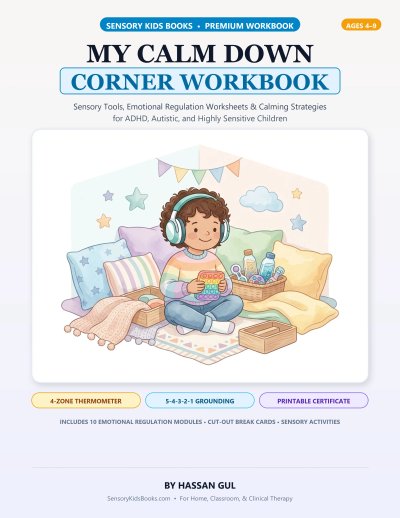
4. Tactile & Emotional Regulation Kit: Stock an interior wall pocket with non-disruptive tactile tools: a slow-rebound memory foam squishie, a liquid motion bubbler, a reversible sequin pillow, and a copy of "My Calm Down Corner Workbook" with printable emotion wheels.
5. Auditory Attenuation (Sound Dampening): Hang a pair of high-attenuation sensory noise-canceling headphones (such as Alpine Muffy or Baby Banz) right by the entrance flap so your child can slip them on as they enter.
The 4-Phase Sensory Decompression Protocol: What to Do During a Meltdown
A sensory tent is a sacred safe space—it should NEVER be used as a "time-out" or disciplinary punishment. If a child associates the tent with isolation or anger, its therapeutic value is ruined forever. Here is the clinical 4-phase protocol to guide your child from acute distress to calm:
Phase 1: Invitation Without Demands (0–2 Minutes)
When you spot the early warning signs (clenched fists, rapid blinking, pacing, verbal repetition), do not give long verbal explanations. Simply open the tent flap, turn on the soft fairy lights, and say in a neutral, whisper-level voice: "Your tent is ready. You can go inside and rest your eyes."
Phase 2: Somatic Reset & Low Demand (2–10 Minutes)
Close the flap halfway or let your child zip it shut. Stand or sit quietly outside the tent within arm's reach. Do not ask "What happened?" or "Why did you yell?" Allow the absence of visual photons and the proprioceptive cushions to calm their amygdala.
Phase 3: Gentle Co-Regulation Check-In (10–15 Minutes)
Once breathing slows down and crying ceases, slide a visual timer or a sensory water bottle through the entrance flap. Ask a low-demand question: "Would you like me to sit inside with you, or do you want 5 more minutes of quiet?"
Phase 4: Low-Velocity Re-Entry (15+ Minutes)
Never pull a child straight from a dark sensory pod back into bright room lights or noisy homework. Open the tent flaps gradually to let natural light filter in slowly, offer a glass of cold ice water, and engage in a calming sensory activity before returning to family routines.
How to Add a Blackout Sensory Tent to Your Child's 504 Plan or IEP
Many parents do not realize that sensory regulation spaces are legally protectable educational accommodations under Section 504 of the Rehabilitation Act and the Individuals with Disabilities Education Act (IDEA). If your child attends public school and experiences sensory overload during lunch, recess, or transitions, you can request a pop-up sensory tent in the classroom or resource room.
Here is the exact wording our sensory consultants recommend bringing to your next 504 or IEP meeting:
"Student will be permitted self-initiated or staff-prompted access to a designated low-arousal sensory decompression space (such as a blackout sensory pod/tent equipped with weighted tools, visual timers, and noise reduction headphones) for up to 15 minutes when displaying physiological indicators of sensory over-responsivity or acute dysregulation. Use of this space shall be treated as an proactive educational accommodation, not a disciplinary consequence, and shall take place without penalty or academic loss."
Summary & The Architect's Final Verdict
Creating an emotionally safe home for a neurodivergent child does not require rebuilding your entire house or spending thousands of dollars on specialized sensory rooms. By introducing a single, well-engineered blackout sensory tent into a quiet corner of your child's bedroom, you give their nervous system a dedicated reset button.
If you need the fastest, most reliable all-round blackout tent, the ODOXIA Pop-Up Blackout Tent is our #1 top recommendation. If you are dealing with aggressive kicking or need a clinic-grade enclosure, invest in the Special Supplies Heavy-Duty Pod. And if bedtime sleep battles are draining your family's sanity, install the Alvantor Bed Canopy over their twin mattress.
For fillable visual calm down routines, emotion check-ins, and printable sensory diet schedules to pair with your new tent, explore our complete interactive resource collection below.
Turn your sensory tent into a step-by-step emotional co-regulation station with our clinician-approved printable workbook. Includes visual emotion meters, deep breathing maze cards, and sensory de-escalation tracking charts.
Explore the Workbook at Sensory Kids Books: https://sensorykidsbooks.com/shop/my-calm-down-corner-workbook
 Instant PDF
My Calm Down Corner Workbook
Sensory Tools, Emotional Regulation Worksheets & Calming Strategies for ADHD, Autistic, & Sensitive Kids (Ages 4–9)
Quick Answers for Parents & Educators
Recommended Sensory Products
Carefully curated products for a sensory-friendly environment.
ODOXIA Pop-Up Blackout Sensory Tent for Kids (47" x 47" x 47")
BEST OVERALL BLACKOUT SENSORY TENT FOR MELTDOWN DECOMPRESSION
~$79–$89 | Ultra-dense light-blocking multi-ply fabric eliminates 99% of ambient visual stimulation. Pops open in 3 seconds flat without poles. Features dual mesh cross-ventilation flaps and integrated floor ties.
Special Supplies Heavy-Duty Dark Den Sensory Tent
BEST CLINIC-GRADE & HEAVY-DUTY THERAPY TENT
~$89–$109 | Built with tear-resistant 300D Oxford cloth and heavy-gauge spring steel. Accommodates two children or a child plus parent for co-regulation. Includes storage pockets for sensory tools and visual timers.
L'Arche Sensory Blackout Tent with Ambient LED Star Ceiling
BEST FOR VISUAL SENSORY SEEKERS & HYPO-REACTIVE SENSORY PROFILES
~$95–$119 | Complete sensory den package featuring interior hanging loops for fiber-optic tails and battery-operated warm starlight LEDs. Turns darkness into a mesmerizing, predictable light-show haven.
Alvantor Twin Bed Blackout Privacy Tent & Sleep Canopy
BEST SENSORY BED CANOPY FOR NIGHTTIME ANXIETY & SLEEP RESTORATION
~$119–$149 | Slips directly over a standard twin mattress to build a cocoon-like sanctuary. Cuts out hallway light, digital screens, and morning glare while offering 4-door zippered mesh access for maximum breathability.
Pacific Play Tents Sensory "Find Me" Dome Tent with Tunnel Port
BEST BUDGET & COMPACT PLAYROOM SENSORY HIDEAWAY
~$42–$52 | Lightweight fiberglass construction with durable 70-denier polyester. Features large mesh ventilation panels, a roll-up door, and an integrated connection cuff for sensory tunnels.
Harkla Hug Inflatable Sensory Peapod Chair & Canoe
BEST DEEP-PRESSURE & PROPRIOCEPTIVE COCOON (OPEN TOP)
~$89–$110 | Soft flocked vinyl canoe applies therapeutic deep touch pressure (DTP) along the entire torso and legs. Ideal for neurodivergent children who need calming physical compression without closed dark spaces.
📚 Evidence-Based Sources & Citations
Peer-reviewed literature, clinical frameworks, and foundational neurodiversity resources referenced in this guide.
- Sensory Environmental Modifications and Their Impact on Classroom Behaviors in Children with Autism — American Journal of Occupational Therapy (AJOT)(2023)View Sourceopen_in_new
- Neural Mechanisms of Sensory Over-Responsivity in Autism Spectrum Conditions — Frontiers in Integrative Neuroscience(2022)View Sourceopen_in_new
- Environmental Design Guidelines for Neurodivergent Children: Sensory Rest & Low-Arousal Architecture — Journal of Autism and Developmental Disorders(2024)View Sourceopen_in_new
- The Physiological Effects of Deep Touch Pressure on Arousal and Meltdown Duration — Journal of Occupational Therapy, Schools, & Early Intervention(2021)View Sourceopen_in_new
Join the Conversation
Get our monthly guide on sensory-aware parenting and neuro-inclusive home design delivered straight to your sanctuary.
Respecting your inbox and your peace of mind.
Leave a Reply
Your email address will not be published. Required fields are marked *