How to Create a Calm Sensory Corner at Home (On a Budget)

A calm sensory corner is a designated low-stimulation home sanctuary equipped with soft lighting, weighted pillows, tactile tools, and visual calm-down charts to help children self-regulate.
When my child was first diagnosed with Sensory Processing Disorder, I made the mistake of browsing expensive occupational therapy catalogs. I saw thousand-dollar sensory swings, massive bubble tubes, and specialty crash pads. I immediately felt overwhelmed—did I need to convert my entire living room into a high-end clinic?
The answer is a resounding no. You do not need to spend a fortune to support your child’s nervous system. Over the years, I’ve learned that the most effective regulation spaces are often the simplest. Here is how to create a calm sensory corner at home on a tight budget.
1. Define the Space (Keep It Small)
Sensory overload makes the world feel too big, too loud, and too bright. A calm corner should feel like a safe, enclosed den. You don’t need a dedicated room. A quiet corner of a bedroom, a cleared-out closet, or the space under a loft bed works perfectly.
If you have an open space, use a cheap pop-up play tent or simply drape a dark, heavy blanket over two chairs. The goal is to reduce visual clutter and create a physical boundary between the "busy" house and the "safe" space.
2. The "Touch" Element: Repurpose What You Have
Proprioceptive and tactile input are incredibly grounding for a dysregulated nervous system. Instead of buying an expensive crash pad, I repurposed an old foam mattress topper, folded it in half, and covered it with a soft duvet cover.
You can also use old couch cushions, a rolled-up yoga mat, or oversized pillows. If you can’t afford a weighted blanket, layering three or four regular, heavy winter blankets provides a remarkably similar deep-pressure sensation.
3. Master the Lighting and Sound
Harsh overhead lighting is a major trigger. Keep the sensory corner dimly lit. A cheap set of warm-white string lights (fairy lights) draped inside the tent provides just enough illumination without being abrasive.
For sound, you don’t need a fancy sound machine. An old oscillating fan provides excellent white noise to drown out household chatter. I also highly recommend keeping a pair of basic noise-canceling earmuffs inside the corner at all times.
4. Stock the Corner with Visual Escapes
When a child is in the corner, they need low-demand tools to help them downregulate. This is where I rely heavily on visual supports and specific reading materials.
I always keep a copy of Emotion Monstersin our tent. Reading a story about processing big feelings while physically sitting in a quiet place is incredibly powerful. Similarly, The Calm Chairis a staple for us, teaching kids that having a designated spot to retreat is a healthy, positive choice.
💡 My Top Budget Finds: If you are looking for specific items, I highly recommend picking up a basic shopping_cart5-pound weighted blanketopen_in_new, some shopping_cartnoise reduction earmuffsopen_in_new, and a shopping_cartsimple white noise machineopen_in_new. You can find all of my curated Amazon affiliate picks below, which are exact replicas of the budget tools we use daily.
The Golden Rule of the Sensory Corner
Never use the sensory corner as a "time-out" or punishment zone. It must remain a positive, voluntary sanctuary. By keeping it simple, affordable, and focused on your child’s unique sensory profile, you can build a powerful tool for emotional regulation right in your own home.
📖 Related reading: Learn How to Set Up the Ultimate Printable ADHD Morning Routine Chart
 Instant PDF
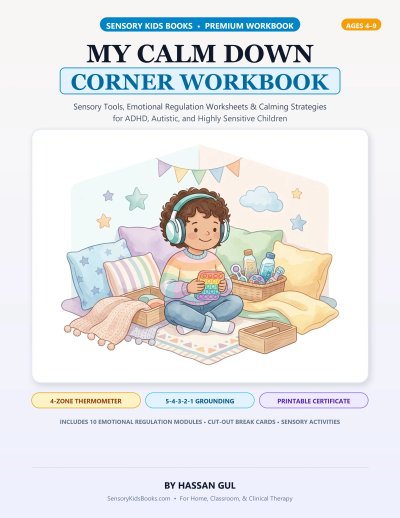
My Calm Down Corner Workbook
Sensory Tools, Emotional Regulation Worksheets & Calming Strategies for ADHD, Autistic, & Sensitive Kids (Ages 4–9)
Quick Answers for Parents & Educators
Recommended Sensory Products
Carefully curated products for a sensory-friendly environment.

Sensory Weighted Blanket (5 lbs)
ESSENTIAL CALMING
Provides deep pressure therapy to immediately soothe the nervous system in the sensory corner.

Noise Reduction Earmuffs
BUDGET PICK
Block out chaotic household noises instantly. Perfect for preventing auditory overload.

Portable White Noise Machine
BEST SOUND MASKING
Drowns out unpredictable background noise with consistent, soothing soundscapes.
Join the Conversation
Get our monthly guide on sensory-aware parenting and neuro-inclusive home design delivered straight to your sanctuary.
Respecting your inbox and your peace of mind.
Discussion (0)
No comments yet. Be the first to share your thoughts!
Leave a Reply
Your email address will not be published. Required fields are marked *