How to Build a Calm Down Corner (That Isn't a Punishment)

Traditional time-outs isolate children during fight-or-flight, increasing panic. Here is the neurobiology of true co-regulation—and the exact blueprint to build a calming sensory haven your child will love.
When I was a kid growing up with an undiagnosed neurodivergent nervous system, 'calming down' usually meant being marched to a wooden chair in the corner of the room. I was told to sit there for five minutes to 'think about what I had done.'
Here is what actually happened in my brain during those five minutes: I didn't reflect on my behavior. I didn't learn emotional regulation. My sympathetic nervous system perceived the sudden isolation and stern commands as an acute social threat. My heart pounded, my ears burned, and my nervous system escalated from sensory overload into primal panic.
Traditional 'time-outs' operate on a flawed premise: that a dysregulated child is deliberately choosing defiance and simply needs punishment to learn compliance. But neuroscience tells us the exact opposite.
A child in the middle of a sensory meltdown or emotional explosion has suffered an amygdala hijack. Their prefrontal cortex—the seat of logic, speech, and impulse control—is physically offline. Sending an overwhelmed child into forced isolation doesn't regulate their nervous system; it floods it with toxic shame and abandonment terror.
A true Calm Down Corner is not a disciplinary holding cell. It is a dedicated, sensory-supportive haven designed to foster co-regulation, somatic grounding, and emotional safety. In this guide, I'll walk you through the exact neuroscience, physical architecture, and step-by-step setup we use to build a calm down corner that kids run toward willingly—not away from in tears.
The Polyvagal Science: Co-Regulation Precedes Self-Regulation
To build an effective calm-down corner, you must understand Dr. Stephen Porges' Polyvagal Theory. The human autonomic nervous system navigates three primary physiological states:
- 🟢 Ventral Vagal (Social Engagement & Safety): Heart rate is steady, facial muscles are expressive, and the child can listen, reason, and empathize. This is where learning and problem-solving occur.
- 🔴 Sympathetic Nervous System (Fight or Flight): The brain perceives danger. Adrenaline surges, pupils dilate, muscles tense, and breathing turns shallow. Behaviors emerge as screaming, kicking, running away, or aggressive defiance.
- 🔵 Dorsal Vagal (Freeze & Collapse): When fight-or-flight fails to restore safety, the nervous system shuts down completely. The child becomes numb, dissociated, curled into a ball, or non-verbal.
Here is the golden rule of pediatric occupational therapy: Children cannot leap from Sympathetic Fight/Flight straight into Ventral Vagal self-regulation on their own.
Self-regulation is not an innate skill; it is a neurological milestone built on years of repeated *co-regulation*. A dysregulated child needs to borrow the calm, steady nervous system of a trusted adult. A calm-down corner provides the low-stimulation physical container where that nervous system co-regulation can take place safely.
The 4 Fatal Mistakes Parents & Teachers Make With Calm Down Corners
If you've previously tried setting up a calm corner and found that your child refused to use it or threw items across the room, you likely ran into one of these four architectural traps:
Mistake 1: Using It as a Threat or Punishment
The moment an adult shouts, 'That's it! Go to your calm corner right now!', the space is permanently tainted. In the child's mind, the sensory tent or beanbag is now synonymous with being bad, rejected, and punished. A calm-down corner must always be an open invitation, never a sentence.
Mistake 2: Sensory Chaos & Visual Clutter
Many Pinterest-inspired calm corners are visual disasters. They feature bright primary colors, busy printed rugs, 20 different plastic toys overflowing from baskets, and harsh overhead fluorescent lighting. To a child already experiencing sensory processing overload, visual clutter is neurological noise that prevents the amygdala from settling down.
Mistake 3: Zero Proprioceptive (Heavy Work) Inputs
Telling an agitated, adrenaline-filled child to 'just sit still and take deep breaths' on a thin carpet is physically impossible. When the body is flooded with motor energy, it requires Deep Touch Pressure (DTP) and proprioceptive input to stimulate the brain's internal map of the body. Without heavy work, the motor restlessness has nowhere to go.
Mistake 4: Introducing the Space During a Meltdown
You cannot teach a drowning person how to swim. If the first time you show your child their calm corner is while they are screaming and kicking, they will reject it violently. The space must be explored, personalized, and practiced during peak calm moments.
The 4 Sensory Zones of an Effective Calm-Down Space
As a technical architect, I treat spaces as functional systems. An evidence-based calm corner should be broken down into four distinct somatosensory zones:
Zone 1: The Protective Boundary (Enclosure & Lighting)
Neurodivergent children often crave physical boundaries to feel protected from ambient room stimuli. A pop-up blackout tent, a soft teepee, or a reading canopy creates an immediate visual firewall between the child and the chaotic living room or classroom.
Replace overhead ceiling lights with warm, dimmable LED fairy lights or an amber salt lamp. Research demonstrates that warm, low-lux lighting triggers natural melatonin synthesis and lowers cortisol release.
Zone 2: Proprioception & Deep Touch Pressure (The Reset Zone)
Proprioceptive receptors located in joints and deep muscle tissue send calming signals directly to the reticular activating system in the brainstem. Equip your calm corner with:
- 🛋️ Sensory Crash Pad: A large, foam-filled pad that allows safe crashing, jumping, and deep body burrowing without injury.
- ⚖️ 5-lb Weighted Lap Pad: Provides deep grounding pressure across the thighs to settle fidgeting legs during quiet seated breathing.
- 🐛 Sensory Body Sock: A lycra resistance sleeve that hugs the child from shoulders to feet, providing full-body tactile feedback.
Zone 3: Tactile & Somatosensory Grounding Tools
When speech fails, the hands become the primary interface for nervous system regulation. Provide a curated basket with no more than 3–4 high-impact sensory tools:
- 🎨 Occupational Therapy Putty: Resistant silicone putty that requires physical squeeze effort, releasing muscular tension in hands and forearms.
- ⏳ Liquid Motion Bubbler: A slow-drip visual anchor that synchronizes rapid saccadic eye movements and slows cardiovascular pacing.
- 💎 Discreet Sensory Chew Jewelry: Satisfies oral-motor proprioceptive cravings and prevents shirt collar chewing during anxiety.
Zone 4: Non-Verbal Emotional Scaffolding & Visual Printables
During sensory flooding, verbal language is often lost. Having laminated visual aids mounted on the wall allows non-speaking or dysregulated children to point to their needs without having to articulate complex sentences.
- 📊 The Feelings Thermometer: Helps children point to Blue (Tired), Green (Calm), Yellow (Alert/Fidgety), or Red (Overwhelmed) zones.
- 🌬️ Tactile Finger-Tracing Breathing Mazes: Large printed Box Breathing cards with directional arrows that children trace with their index fingers.
Recommended Physical Tools to Build Your Calm-Down Space
To build a durable, high-impact sensory haven that lasts across multiple school years, here are the exact clinical tools we recommend:
1. Pop-Up Sensory Blackout Tent for Kids
Provides an instant, low-stimulation sensory sanctuary that blocks 90% of outside light. Fits perfectly in bedroom or classroom corners and sets up in under 60 seconds.
shopping_cartCheck Price on Amazon: Pop-Up Sensory Blackout Tentopen_in_new
2. Sensory Crash Pad for Kids (Heavy Duty Foam)
Allows children with high sensory seeking needs to safely jump, crash, and burrow. The high-density foam absorbs high-energy impacts and provides deep pressure feedback.
shopping_cartCheck Price on Amazon: Sensory Crash Pad for Kidsopen_in_new
3. 5-lb Weighted Lap Pad with Soft Minky Dots
Engineered with dual-sided sensory textures—smooth cooling cotton on one side and raised minky sensory dots on the other. Delivers targeted Deep Touch Pressure to calm restless bodies.
shopping_cartCheck Price on Amazon: Weighted Lap Pad for Kids (5 lbs)open_in_new
4. Dual-Color Liquid Motion Bubbler Timer
A soothing visual focus timer that captures attention during emotional floods, helping slow rapid breathing and quiet anxious thoughts effortlessly.
shopping_cartCheck Price on Amazon: Liquid Motion Bubbler Sensory Toyopen_in_new
How to Introduce the Calm-Down Corner Without Triggering Demand Avoidance
For children with ADHD, Autism, or Pathological Demand Avoidance (PDA), even helpful tools can trigger instant defiance if presented as a mandatory directive. Here is our 4-step low-demand rollout protocol:
Step 1: Involve Your Child in the Architecture
Do not build the corner secretly and unveil it as a surprise. Let your child choose which corner of the room to use. Let them bring their favorite soft blanket, stuffed animals, and books. Ask them: 'What should we name our quiet space?' Giving them ownership over the name (e.g. 'The Fortress of Solitude', 'The Bear Cave') establishes immediate autonomy.
Step 2: Model Adult Usage First
Children mirror adult nervous systems. When you feel yourself becoming overwhelmed by work emails or household chaos, announce your regulation openly: 'My body is feeling a little Yellow and tired right now. I'm going to sit in the sensory tent with my weighted pillow for 5 minutes.' Seeing a parent use the space normalizes regulation as a healthy human need rather than a punishment.
Step 3: Practice During Green Zone Times
Spend 10 minutes a day reading stories, drawing, or trying the finger-tracing breathing mazes inside the corner while everyone is calm and happy. This builds positive somatic memory so that the brain associates the corner with peace, not conflict.
Step 4: Use Declarative Language Invitations
When you notice your child's fists clenching or vocal volume rising into the Yellow Zone, never shout commands. Use low-demand declarative phrasing:
- ❌ Avoid Saying: 'You need to go to your calm down corner right now!'
- ✅ Say Instead: 'I notice your hands are clenching and your body has a lot of big energy. The crash pad is ready if you want a soft landing.'
- ✅ Say Instead: 'I'm going to turn on the fairy lights in the cozy tent. You are welcome to join me whenever you're ready.'
Free Download & Recommended Workbooks for Your Calm Corner
To help you stock your calm-down space with evidence-based visual aids, check out our dedicated publications:
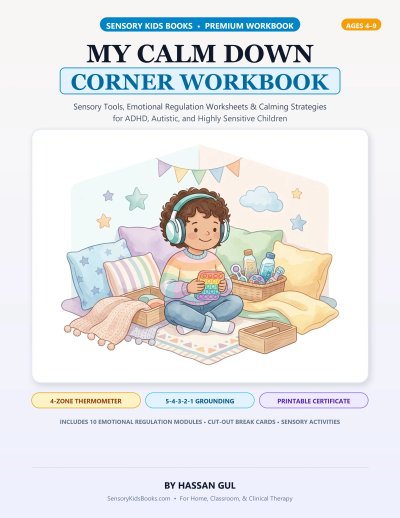
📖 My Calm Down Corner Workbook by Hassan Gul — Features 35+ full-color visual check-in charts, breathing mazes, and sensory diet schedules.
📥 Looking for immediate free printables? Download our complete Free 5-Page Self-Regulation Workbook Starter Kit (Instant PDF) featuring tactile box breathing paths and feelings thermometers ready to print and laminate today.
 Instant PDF
My Calm Down Corner Workbook
Sensory Tools, Emotional Regulation Worksheets & Calming Strategies for ADHD, Autistic, & Sensitive Kids (Ages 4–9)
Quick Answers for Parents & Educators
Recommended Sensory Products
Carefully curated products for a sensory-friendly environment.
Pop-Up Sensory Blackout Tent
Visual Decompression
Instant pop-up blackout tent that blocks 90% of outside light to reduce sensory overwhelm.
Sensory Crash Pad for Kids
Heavy Work & Proprioception
Durable foam-filled crash pad that provides safe, high-impact proprioceptive joint feedback.
5-lb Weighted Lap Pad (Minky Dots)
Deep Touch Pressure
Targeted calming weight across thighs and chest with raised sensory tactile dots.
Liquid Motion Bubbler Sensory Toy
Visual Grounding Anchor
Mesmerizing dual-color slow drip timer that calms rapid breathing and quiets overstimulated eyes.
Join the Conversation
Get our monthly guide on sensory-aware parenting and neuro-inclusive home design delivered straight to your sanctuary.
Respecting your inbox and your peace of mind.
Discussion (0)
No comments yet. Be the first to share your thoughts!
Leave a Reply
Your email address will not be published. Required fields are marked *