Social Confidence for Neurodivergent Teens: How to Decode Unspoken Rules Without Masking
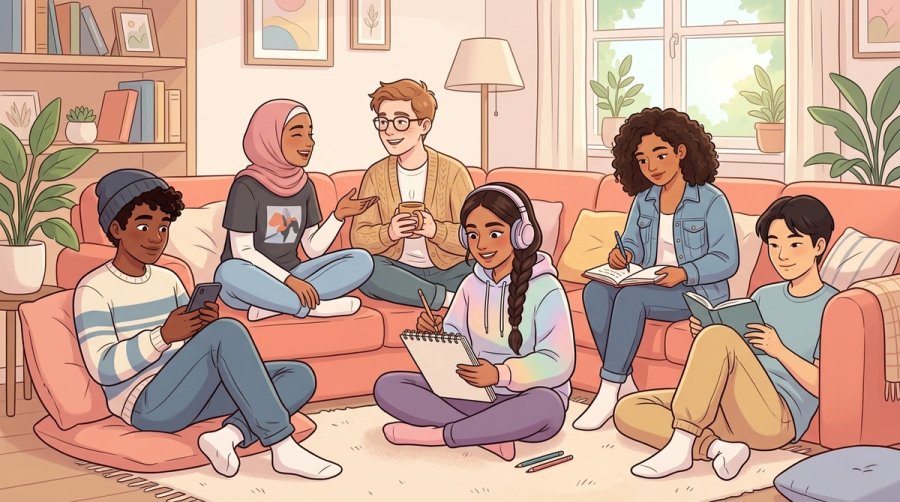
High school feels like everyone else got the rulebook? Here is the unwritten social guide for autistic and ADHD teens—how to decode social subtext without losing who you are.
High school is an unwritten, high-stakes game. And for an autistic or ADHD teenager, it feels like everyone else was handed a 300-page rulebook at birth—except for them.
Why did that person leave them on 'read' for four days? Why did the lunch table go completely silent after they shared an interesting fact about aerospace engineering? Why do peers say 'That's so cool' when their facial expression clearly means 'Please stop talking'?
For decades, traditional schools attempted to fix this with 'Social Skills Groups'—programs that essentially taught autistic teens how to mask: force uncomfortable eye contact, fake interest in boring pop culture, suppress natural stims, and perform neurotypical conversation scripts.
📄 Looking for a printable cheat sheet? Download the 52 Modern Manners for Teens 8-Page Sample Chapter & Social Cheat Sheet (Free PDF) — Includes the unspoken rules checklist, peer boundaries matrix, and self-advocacy scripts.
Here is the devastating cost of forced social skills training: Research shows that autistic individuals who score highest on social masking tests suffer the highest rates of clinical depression, chronic anxiety, and teenage suicidal ideation. Masking is not social success; it is a psychological prison.
In this modern, empowering guide, we reject forced masking. Instead, we approach social confidence from a perspective of **Social Translation and Unspoken Rule Decoding**. We teach neurodivergent teens how to decode neurotypical social architecture without changing who they are, how to manage Rejection Sensitive Dysphoria (RSD), and how to build authentic, reciprocal friendships.
The 'Double Empathy Problem': Why Communication Breaks Down
For years, psychology textbooks claimed that autistic individuals lack empathy. In 2012, autistic sociologist **Dr. Damian Milton** dismantled this deficit model with his revolutionary **Double Empathy Problem** theory:
- 🧩 The Two-Way Street: Autistic people do not lack empathy. Communication friction occurs because autistic and neurotypical individuals have completely different cognitive, sensory, and linguistic operating systems.
- 🤝 Peer-to-Peer Fluency: Studies show that autistic people communicate with other autistic people with incredible warmth, mutual empathy, and clarity! The breakdown only occurs when translating across neurotypes.
Teaching social confidence is not about 'fixing' an autistic teen. It is about giving them a bilingual social translation dictionary so they can navigate the neurotypical world safely while staying true to their autistic identity.
The 4 Core Unspoken Rules Every Neurodivergent Teen Needs Decoded
Here are four common social minefields decoded explicitly:
1. The 'Ping-Pong' Rule of Conversation
Autistic communication often relies on 'Info-Dumping'—sharing deep, passionate monologues about special interests. To an autistic person, info-dumping is a gesture of love and trust. But neurotypicals perceive conversations like a game of ping-pong: one serve, one return.
- 💡 The Translation: Teach the 3-Sentence Check-In: After speaking three sentences about your special interest, pause and ask: 'Have you ever gotten into this topic?' If they respond with short, flat answers ('No, not really'), that is your cue to pass the paddle back.
2. The Digital Messaging Delay Matrix
Teen group chats and DMs are breeding grounds for RSD panic. An un-replied text registers as: 'They hate me.'
- 📱 The Translation: People do not live in their message inbox. Leaving someone on read often means they are in class, their phone died, or their social battery is depleted. Establish a personal rule: Never send more than two consecutive un-replied texts. If no response comes within 24 hours, move on.
3. The 'Indirect No' (Decoding Politeness Subtext)
Neurotypical peers rarely say a direct 'No' because they fear confrontation. They use softening phrases:
- 🗣️ 'Maybe' / 'I might be busy': Usually translates to: 'No, I don't want to go.'
- 🗣️ 'We should definitely hang out sometime!': Often a polite pleasantry, not an actual invitation, unless accompanied by a specific date and location.
4. Managing Rejection Sensitive Dysphoria (RSD)
When an exclusion happens (not being invited to a party), an ADHD/autistic nervous system experiences physical pain. Teach teens the 'Pause & Check' technique: 'My nervous system is in pain right now, but a missed invitation does not define my worth as a human being.'
Recommended Social Confidence Tools for Neurodivergent Teens
Equip your teen with low-demand tools for modern social navigating:
1. Social Conversation Starter Dilemma Cubes
Thought-provoking conversation cards that give teens scripted, safe topics to initiate group discussions without awkwardness.
shopping_cartCheck Price on Amazon: Conversation Starter Cards for Teensopen_in_new
2. The Field Guide to Human Body Language Pocket Book
A visual, illustrated guide that breaks down micro-expressions, posture, and non-verbal social cues like an analytical field manual.
shopping_cartCheck Price on Amazon: Body Language Guide for Teensopen_in_new
3. Discreet Sensory Fidget Ring (Stainless Steel Spinner)
A stylish, wearable spinner ring that allows teens to self-regulate anxiety and stim silently during high-stress social gatherings.
shopping_cartCheck Price on Amazon: Stainless Steel Fidget Spinner Ring for Teensopen_in_new
4. Loop Engage Sound-Softening Earplugs for Teens
Reduces loud cafeteria, hallway, and party background chatter by 16 dB while keeping speech crystal clear, preventing sensory burnout.
shopping_cartCheck Price on Amazon: Loop Engage Earplugs for Socializingopen_in_new
Explore 52 Modern Manners for Teens (Expanded Edition)
To give your teen a comprehensive, hilarious, and deeply relatable manual for decoding modern high school life, explore our flagship publication:
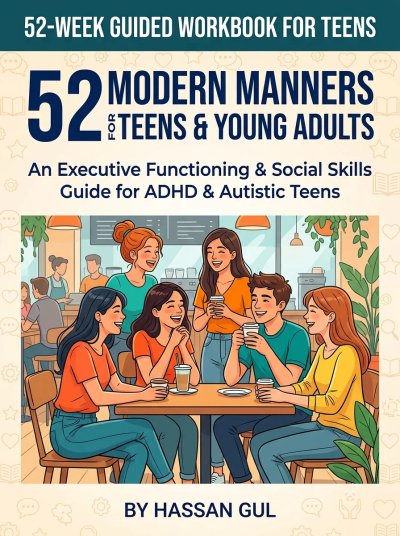
📖 52 Modern Manners for Teens & Young Adults (Expanded Edition) by Hassan Gul. Features 52 real-world chapters covering digital boundaries, texting rules, job interviews, and dating without masking.
📥 Download our Free 5-Page Self-Regulation Starter Kit (PDF) for tactile calming mazes and feelings thermometers.
 Instant PDF
52 Modern Manners for Teens & Young Adults (Expanded Edition - Version 2)
The Complete Guided Social Skills & Executive Functioning Workbook: Reading Lessons, Real-World Scripts, Talking Points & Practice Tracker (Ages 13–18+)
Quick Answers for Parents & Educators
Recommended Sensory Products
Carefully curated products for a sensory-friendly environment.
Conversation Starter Cards for Teens
Social Icebreaker Tools
Engaging prompt cards that eliminate awkward silences and help teens initiate low-pressure conversations.
Visual Body Language Field Guide
Subtext Decoder
Analytical visual handbook decoding micro-expressions and posture without clinical jargon.
Stainless Steel Fidget Spinner Ring
Discreet Anxiety Ring
Fashionable sensory spinner ring that provides subtle tactile proprioception during high school social anxiety.
Loop Engage Social Earplugs
Party Sensory Armor
Acoustic filters that eliminate background party chatter while allowing clear one-on-one dialogue.
Join the Conversation
Get our monthly guide on sensory-aware parenting and neuro-inclusive home design delivered straight to your sanctuary.
Respecting your inbox and your peace of mind.
Discussion (0)
No comments yet. Be the first to share your thoughts!
Leave a Reply
Your email address will not be published. Required fields are marked *