The Spoon Theory for Kids: How to Teach Energy Budgeting to Prevent Autistic Burnout

Angel at school, explosion at home? It is not bad behavior—your child ran out of spoons. Here is how to teach energy budgeting to prevent autistic burnout and restore family calm.
It is Friday afternoon. Your autistic or ADHD child was an absolute angel at school all week. Their teacher sent glowing reports: 'Emma sat quietly, finished all her worksheets, and was so polite!'
Then she walks through your front door, kicks off her shoes, and within 90 seconds, detonates into an explosive 45-minute meltdown over the wrong brand of crackers.
Parents are often left bewildered and heartbroken: 'Why does she hold it together for her teacher, but scream and fall apart with me?'
Here is the answer that medical professionals rarely explain clearly: Your child did not have a behavior relapse. They ran completely out of spoons.
As an autistic adult who suffered severe clinical burnout in my late 20s, I know firsthand what happens when your internal energy battery hits absolute zero. When you force a neurodivergent brain to mask its sensory sensitivities, suppress stimming, navigate social ambiguity, and process harsh fluorescent lights all day, it drains a finite neurological energy reserve.
In this comprehensive guide, we translate Christine Miserandino's famous **Spoon Theory** into child-friendly visual language. You will learn how to teach your child energy budgeting, identify hidden 'Spoon Thieves,' and prevent devastating autistic burnout before it starts.
What Is the Spoon Theory? (The Neurodivergent Energy Bank)
The Spoon Theory was originally created in 2003 by chronic illness advocate Christine Miserandino to explain lupus fatigue. In recent years, it has become the gold-standard metaphor in autistic, ADHD, and neurodivergent communities.
Imagine every person wakes up each morning with a finite handful of spoons. Each spoon represents one unit of physiological, sensory, and cognitive energy:
- 🔋 Neurotypical Energy: A neurotypical child wakes up with 50 spoons. Basic tasks like brushing teeth, wearing socks, riding the bus, and sitting under fluorescent lights cost zero spoons—their brain automates them effortlessly.
- 🪫 Neurodivergent Energy: An autistic or sensory-sensitive child may wake up with only 12 spoons. And unlike their peers, everyday sensory friction costs spoons before school even begins: tagless shirt scratch (1 spoon), sock toe seam (1 spoon), chewing breakfast textures (1 spoon), loud bus ride (3 spoons). By the time they sit down for math class, half their spoons are already gone!
When an autistic child reaches 0 spoons and demands continue to pile on, their nervous system crashes into **Autistic Burnout**—a state of chronic physical exhaustion, loss of speech, executive shutdown, and emotional dysregulation.
The 4 Hidden 'Spoon Thieves' in a Child's Day
Most adults only count academic effort. But for an autistic child, the biggest energy drains are invisible sensory and social taxes:
1. Sensory Flooding & Auditory Friction
Processing multi-directional sound, cafeteria clatter, bright fluorescent tubes, and temperature shifts requires continuous active suppression by the brain. It is like running a demanding software application in the background of your phone all day—the battery drains twice as fast.
2. The Masking Tax (Camouflaging Autistic Traits)
Suppressing the urge to rock, hand-flap, pace, or vocalize to avoid looking 'weird' to peers is called autistic masking. Clinical studies show that continuous masking is the single highest statistical predictor of childhood anxiety, depression, and teenage burnout.
3. Micro-Transitions & Task Shifting
Moving from reading to math, packing up a backpack, lining up for recess, entering the lunchroom—every unexpected shift in environment requires massive cognitive reorganization that costs 2 to 3 spoons each time.
4. Social Decoding & Masking Communication
Deciphering sarcasm, idioms, subtle peer facial expressions, and unwritten playground rules requires deliberate manual computing rather than instinctual intuition.
How to Teach Spoon Budgeting to Kids (The 3-Step System)
You can easily make this abstract concept concrete and empowering for children:
Step 1: Use Physical Visual Spoons
Buy a pack of 12 cheap wooden or plastic spoons. Each morning, hand your child their 12 spoons or set up a magnetic spoon chart on the refrigerator. Throughout the day, let them physically hand you a spoon when a task feels draining: 'That noisy assembly cost me 2 spoons.' Visualizing the pile shrinking gives them immediate somatic awareness.
Step 2: Build a 'Spoon Restoring' Menu
Just as tasks cost spoons, sensory soothing activities can recharge the battery by 1 or 2 spoons:
- 🛌 +2 Spoons: 20 minutes inside a dark sensory blackout tent with noise-canceling headphones.
- 🛀 +1 Spoon: A warm bath with Epsom salts and dim lighting.
- 🎧 +2 Spoons: Listening to favorite special interest audiobooks without anyone speaking to them.
- 🎨 +1 Spoon: Solo hyperfocus drawing or building LEGO bricks in silence.
Step 3: Honor the 'Zero Spoons' Boundary
When your child arrives home from school and says, 'Mom, I have 1 spoon left,' that is your signal to drop all non-essential demands. Cancel the grocery trip. Postpone the piano lesson. Serve dinner on a tray in their bedroom. Respecting their low battery prevents restraint collapse meltdowns.
Recommended Sensory Recharging Tools for Neurodivergent Kids
Here are four essential tools to help your child restore their daily spoon supply:
1. Sensory Blackout Pop-Up Tent
Creates an instant zero-lux sensory retreat that blocks light and visual noise, allowing rapid nervous system recharge.
shopping_cartCheck Price on Amazon: Sensory Blackout Pop-Up Tentopen_in_new
2. 5-lb Weighted Shoulder & Lap Wrap
Drapes gently around the shoulders or thighs, providing deep proprioceptive grounding to replenish depleted spoons.
shopping_cartCheck Price on Amazon: Weighted Shoulder Lap Wrap for Kidsopen_in_new
3. Magnetic Visual Daily Battery Tracker Board
A colorful refrigerator board with movable battery slider tokens so kids can show their energy level non-verbally.
shopping_cartCheck Price on Amazon: Visual Battery Energy Tracker Chartopen_in_new
4. Loop Engage Kids Noise-Softening Earplugs
Reduces ambient cafeteria and classroom noise by 16 decibels while keeping speech crystal clear, preventing auditory spoon theft.
shopping_cartCheck Price on Amazon: Loop Engage Kids Earplugsopen_in_new
Explore 'Empty Battery' & The Spoonie Planner
To help children understand energy budgeting through engaging storytelling, explore our published resources:
📖 Empty Battery (Book 19) by Hassan Gul. A touching illustrated storybook that follows a sensory-sensitive child learning to communicate their energy limits without shame.
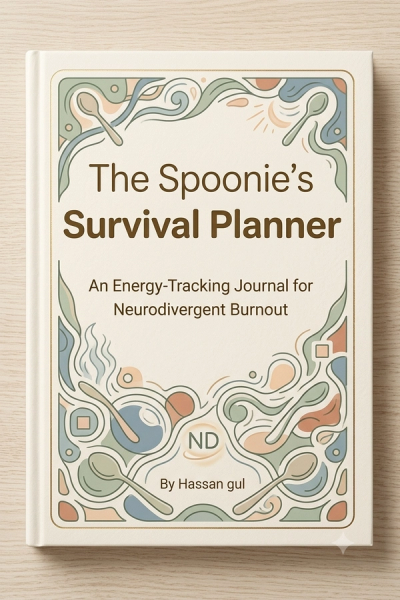
📖 For older kids and chronic fatigue, explore The Spoonie's Survival Planner (Book 10).
📥 Download our Free 5-Page Self-Regulation Starter Kit (PDF) for tactile calming mazes and feelings thermometers.
 Instant PDF
The Spoonie's Survival Planner
A Low-Demand, Sensory-Friendly Energy Tracker & Planner for Autistic and Neurodivergent Minds
Quick Answers for Parents & Educators
Recommended Sensory Products
Carefully curated products for a sensory-friendly environment.
Sensory Blackout Pop-Up Tent
Zero-Lux Recharge Cave
Blocks outside light and environmental stimuli to allow rapid nervous system replenishment during low spoon states.
Weighted Shoulder & Lap Wrap (5 lbs)
Deep Touch Grounding
Provides soothing proprioceptive sensory pressure across neck and shoulders to settle burnout exhaustion.
Visual Battery Energy Tracker Board
Non-Verbal Communication
Magnetic visual battery slider chart allowing children to communicate depleted energy reserves without speaking.
Loop Engage Kids Earplugs
Spoon Theft Defense
Discreet hearing protection that reduces loud background noise by 16 dB while keeping conversations clear.
Join the Conversation
Get our monthly guide on sensory-aware parenting and neuro-inclusive home design delivered straight to your sanctuary.
Respecting your inbox and your peace of mind.
Discussion (0)
No comments yet. Be the first to share your thoughts!
Leave a Reply
Your email address will not be published. Required fields are marked *