The Ultimate 504 Plan Accommodations List for ADHD: 45+ Legally Enforceable Classroom Clauses & Meeting Scripts
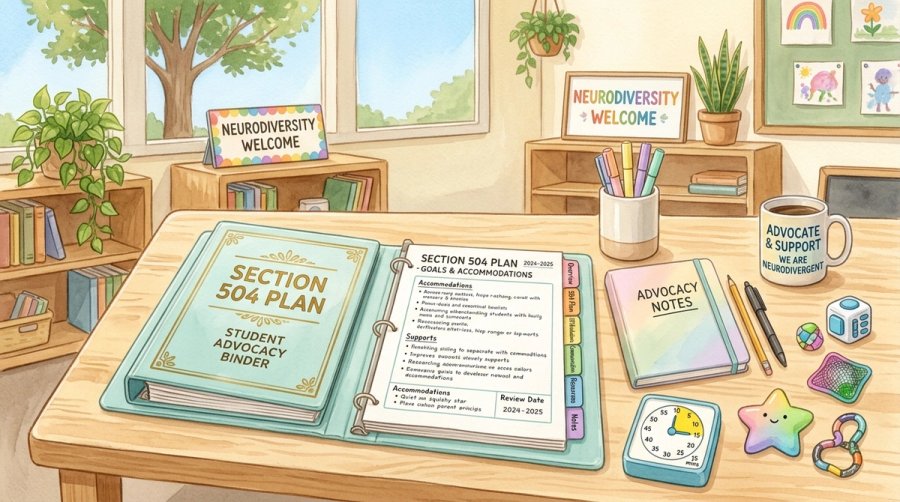
Turn vague school promises into legally binding support. Explore our master list of 45+ Section 504 plan accommodations for ADHD, word-for-word parent meeting scripts, and legal non-negotiables.
Editorial Disclosure & Medical Scope: Sensory Kids Books shares neurodiversity-affirming, lived-experience insights and sensory-informed tools for parents, caregivers, and educators. This publication is for educational purposes only and does not constitute formal medical diagnosis, psychiatric evaluation, or clinical occupational therapy advice. Always consult a qualified pediatrician or licensed clinician for individual medical care. As an Amazon Associate, we earn from qualifying purchases through our independent affiliate links at zero extra cost to you.
The first Section 504 meeting I ever walked into felt like an ambush disguised as a friendly chat.
The school team had assembled across a long laminate conference table: the principal, the guidance counselor, the general education teacher, and the school psychologist. On their side sat three polished manila folders and a collective air of routine efficiency. On my side sat my yellow legal pad, two hours of anxious research printed at midnight, and an empty stomach.
Within four minutes, the team delivered the speech that tens of thousands of neurodivergent families hear every school year: "Your child is so bright. He participates actively, he has plenty of friends, and his test scores are right around grade level. We already give him extra time informally when he needs it. Writing a formal 504 plan would just label him unnecessarily."
It sounded warm. It sounded collaborative. And it was legally and structurally dangerous.
Because three months later, when the classroom shifted from gentle review to high-volume multi-step worksheets, my child began falling apart. When the sensory din of 26 ten-year-olds sharpening pencils and scraping metal chair legs triggered severe nervous system overload, he put his head down on his desk and shut down. And when a substitute teacher took over for three weeks, those "informal verbal agreements" evaporated like morning mist.
As a systems architect and an author who spends my professional life engineering fault-tolerant digital architectures, I had to learn the cold reality of school advocacy: informal verbal goodwill fails the moment classroom pressure spikes. A Section 504 Plan is not a favor granted by a generous school district. It is a legally binding civil rights document under Section 504 of the Rehabilitation Act of 1973 and Title II of the Americans with Disabilities Act (ADA).
If your child has ADHD—whether primarily inattentive, hyperactive-impulsive, or combined type—their executive dysfunction, working memory limits, and sensory sensitivity are recognized neurological impairments. This master guide provides the exact, legally vetted 504 plan accommodations list for ADHD across every school domain, complete with word-for-word scripts to dismantle administrative pushback and protect your child's dignity in the classroom.
Why Vague Accommodations Fail: The Golden Rule of 504 Precision
The single most common mistake parents make when drafting a 504 plan is accepting vague, subjective language. School districts frequently suggest phrases like:
Vague (Unenforceable): "Teacher will provide frequent check-ins and extra help as needed."
Who decides what "as needed" means? If the teacher is running twenty minutes behind curriculum pacing on a Friday afternoon, they will decide it is not needed. If a substitute walks into the room on Monday morning, they have no idea what "frequent check-ins" entails.
Every enforceable accommodation must pass the Three-Part Precision Test:
1. The Operational Trigger: WHEN and WHERE does the accommodation happen? (e.g., "During all independent writing sessions exceeding 15 minutes...")
2. The Concrete Mechanism: WHAT physical tool or adjustment is provided? (e.g., "...the student will be provided a silent visual countdown timer and a printed 3-step task breakdown...")
3. The Responsible Party: WHO is legally responsible for executing it? (e.g., "...delivered by the classroom teacher or instructional aide before task initiation.")
When you write accommodations with this architectural precision, you remove subjective debate. The accommodation either happened or it was violated under federal civil rights law.
The "Too Smart for a 504" Myth: What Federal Law Actually States
If your school committee attempts to deny eligibility by claiming your child's passing grades or high IQ prove they don't qualify, you must cite the U.S. Department of Education's Office for Civil Rights (OCR) binding guidance.
Under the ADA Amendments Act of 2008 (ADAAA) and Section 504 regulations (34 C.F.R. § 104.3), disability is evaluated based on whether the condition substantially limits one or more "major life activities." Major life activities include learning, but they also explicitly include: concentrating, thinking, communicating, working, and the operation of major bodily functions (including neurological and brain functions).
A child who spends 400% more metabolic and nervous system energy than their peers just to maintain a C+ or B average while suffering severe after-school restraint collapse, homework panic attacks, and daily executive paralysis is substantially limited in concentrating and neurological functioning. High cognitive intelligence does not cure executive dysfunction.
You can download our complete printable binder templates and copy-and-paste legal clauses in The 504 Plan Master Toolkit for ADHD, which includes pre-drafted legal citation cover letters.
Category 1: Executive Function, Working Memory & Task Initiation
ADHD is fundamentally a deficit in executive function. Working memory holds information in the mental workspace long enough to act on it. When a teacher issues a three-part verbal command ("Put your science folders in your cubby, open your workbooks to page 42, and begin question three"), an ADHD child's working memory wipes out after step one. These accommodations externalize memory demands onto physical, visual systems.
1. Chunked Instruction with Visual Anchor: Multi-step classroom directions will be broken into single-step prompts paired with a written or pictorial checklist displayed directly on the student's desk.
2. 2-Step Clarification Check: After delivering group instructions, the teacher or instructional aide will privately check in with the student within the first 90 seconds to verify task initiation and ensure the student understands the first actionable step.
3. Desk-Mounted Visual Countdown Timers: Student is permitted to keep a silent visual analog timer (such as a Time Timer or Secura disc timer) on their desk during all independent work periods to concretely visualize remaining elapsed time.
4. Dual Textbook & Material Sets: School district will provide two complete sets of required curriculum textbooks and heavy workbooks—one set to remain permanently in the classroom and one set to remain at home—eliminating backpack chaos and forgotten material panics.
5. Digital or Teacher-Initialed Daily Planner: Teacher or designated peer mentor will initial the student's physical planner or confirm digital upload of homework assignments 10 minutes prior to dismissal bell.
6. Color-Coded Subject Filing Architecture: All handouts, folders, and notebooks will follow an identical color scheme across disciplines (e.g., Blue = Math, Green = Science, Yellow = Language Arts) with clear open plastic tubs rather than deep zippered folders.
7. Designated 5-Minute Weekly Locker/Desk Cleanout: Student will be provided 5 minutes of designated, non-punitive support time on Friday afternoons with adult scaffolding to sort and empty papers from desk and locker into subject bins.
🛒 Recommended Tool: Visual Countdown Desk Timers (Silent Analog Disc) — shopping_cartCheck Price & Availability on Amazon →open_in_new
Category 2: Physical Movement, Fidget Tools & Somatic Motor Regulation
Hyperactivity in ADHD is not misbehavior; it is the autonomic nervous system's biological attempt to stimulate dopamine production and maintain cognitive alertness. When schools force an ADHD child to sit rigidly still on hard plastic chairs for six hours, the brain enters hypo-arousal and shuts down. These accommodations provide continuous, dignified motor outlets.
8. Flexible Alternative Seating Options: Student will be provided access to dynamic seating tools, including an inflatable wobble cushion, active balance disc, or heavy-duty elastic resistance bands installed on chair legs, allowing quiet proprioceptive motor discharge while seated.
Explore our tested reviews of anti-tip wobble stools, desk bouncy bands, and dynamic balance ball chairs: The 6 Best Active Seating Chairs & Wobble Stools for ADHD Kids (2026 Tested)
9. Scheduled Proprioceptive Heavy-Work Breaks: Student will be assigned scheduled functional movement errands every 45 to 60 minutes (e.g., carrying book bins to the library, wiping down whiteboards, delivering attendance envelopes to the office, moving stackable chairs).
10. Discretionary Silent Sensory Fidget Tools: Student is permitted to hold and manipulate silent, textured sensory tools (e.g., marble-mesh sleeves, textured desk strips, smooth worry stones, silent gyro rollers) during lectures and listening tasks without confiscation.
11. Non-Punitive 3-Minute Restroom & Hallway Movement Pass: Student will be issued a reusable visual lanyard pass allowing them to request one 3-minute hallway walking break per block when feeling motor restlessness, without requiring public justification or peer discussion.
12. Standing Desk Station Option: Classroom will feature an adjustable standing desk or perimeter counter workstation where the student can transition freely between sitting and standing during independent study.
13. The Non-Negotiable Recess Protection Clause: Under no circumstances shall recess, physical education, or outdoor physical activity time be revoked, shortened, or used as a punitive disciplinary consequence or makeup period for incomplete classwork.
🛒 Recommended Tool: Inflatable Wiggle Wobble Cushion & Chair Bands — shopping_cartCheck Price & Availability on Amazon →open_in_new
Category 3: Classroom Seating, Acoustic Comfort & Sensory Distractibility
The ADHD brain struggles with sensory gating—the neurological filter that weeds out irrelevant background noise, flickering fluorescent lights, and hallway movements. If your child is seated next to a pencil sharpener or an open doorway, their nervous system is processing every single footstep instead of the teacher's lesson.
14. Preferential Low-Distraction Perimeter Seating: Student will be seated near the primary instruction zone (front-and-center or side perimeter) away from high-traffic distractions including doorways, pencil sharpeners, classroom windows, HVAC vents, and restroom pathways.
15. Noise-Dampening Acoustic Earplugs or Headphones: Student is authorized to wear high-fidelity noise-dampening acoustic earplugs (such as Loop Engage) or over-ear hearing protection during independent study, writing periods, and cafeteria lunch times.
16. Individual Three-Sided Study Carrel Access: Student will have access to a voluntary, portable three-sided cardboard or felt privacy study shield on their desk during high-focus tasks to eliminate visual peripheral motion.
17. Fluorescent Glare Reduction: Classroom teacher will minimize direct overhead fluorescent harshness using fabric diffuser light filters or permit the student to wear a neutral brimmed cap or tinted indoor glasses when experiencing sensory migraines or visual fatigue.
18. Calm Buddy Seating Partnership: Student will be seated adjacent to a calm, focused peer partner who models self-regulation and task organization, deliberately avoiding placement near students with conflicting behavioral friction.
🛒 Recommended Tool: Noise-Dampening Earplugs for Classroom Focus — shopping_cartCheck Price & Availability on Amazon →open_in_new
Category 4: Testing, Quizzes & In-Class Assessments
Timed standardized tests and pop quizzes trigger catastrophic processing speed freezes for ADHD kids. When anxiety spikes, working memory contracts by up to 50%, transforming a child who understands the material into one who stares at a blank exam page in tears.
19. 1.5x Extended Time on All Evaluative Assessments: Student will receive 50% additional time (time-and-a-half) on all unit exams, pop quizzes, standardized assessments, and in-class timed writing prompts.
20. Alternative Low-Distraction Testing Environment: All major chapter tests and state standardized exams will be administered in a quiet, low-stimulus testing room with a proctor and no more than 6 other test-takers.
21. Chunked Exam Administration with Micro-Breaks: Multi-page examinations will be divided into individual sections, allowing the student a 2-minute somatic motor break between test sections rather than completing the entire assessment in one sitting.
22. Exemption from Penalty for Transposition Errors: On standardized multiple-choice exams, student is permitted to mark answers directly into the test booklet rather than bubbling a separate Scantron optical answer sheet, preventing visual tracking misalignments.
23. Clarification of Ambiguous Test Phrasing: Test proctor is authorized to rephrase or clarify convoluted, multi-clause question prompts without providing factual clues, ensuring comprehension of the prompt itself.
24. Oral Verification for Incomplete Written Answers: If student provides a sparse or incomplete written response on short-answer tests, the teacher will allow a brief oral follow-up where the student can explain their reasoning verbally for full credit.
Category 5: Emotional Regulation, Rejection Sensitivity & Transition Support
Rejection Sensitivity Dysphoria (RSD) is one of the most intense, hidden aspects of ADHD. When a teacher corrects an ADHD child sharply in front of 25 peers, the child experiences acute, overwhelming emotional pain that frequently triggers fight-or-flight panic (meltdowns, sarcasm, or shutting down). These accommodations build a protective buffer around emotional safety.
25. Private Non-Verbal Redirection Cues: Teacher will establish a confidential, non-verbal desk signal (e.g., placing an index card on the corner of the desk or a gentle double-tap on the table) to prompt redirection without publicly embarrassing the child.
26. Advance Notice of Schedule Deviations: Student will be given at least 5 minutes of verbal and visual advance warning prior to classroom transitions, fire drills, guest speaker visits, or changes in daily timetable pacing.
27. Designated Safe Sanctuary Cool-Down Pass: Student will be issued a discreet, non-punitive pass to visit the school nurse, guidance counselor, or calm-down corner for up to 10 minutes when experiencing sensory or emotional red-lining.
28. Declarative Language & Choice Architecture: Staff will utilize low-demand declarative phrasing rather than direct interrogative demands (e.g., "I notice our science binder is on the floor; let's put it on the shelf before lunch" rather than "Pick that up right now").
29. Mandatory De-Escalation Waiting Window: During moments of visible emotional overwhelm or crying, staff will avoid demanding immediate verbal explanations or forcing eye contact, allowing a 10-minute somatic reset period before debriefing.
30. Daily Emotion & Regulation Check-In: Student will complete a 60-second visual feelings check-in (using a 5-point emotion meter) with their homeroom teacher or counselor upon arrival each morning to gauge nervous system readiness.
Category 6: Homework Volume, Grading & Written Output Adjustments
Dysgraphia, fine-motor fatigue, and slow processing speed make physical handwriting agonizing for many ADHD students. When a child spends two hours screaming over math problems they already know how to solve, the homework is actively destroying their mental health without delivering academic value.
31. Reduced Practice Volume (Concept Mastery Standard): Homework assignments with repetitive problem sets will be reduced by 50% (e.g., completing odd-numbered math problems only) provided the student demonstrates mastery of the core concept.
32. Speech-to-Text & Assistive Word Processor Authorization: Student is authorized to use voice-to-text dictation software (Google Voice Typing) or an approved digital keyboard for all long-form written responses exceeding one paragraph.
33. Exemption from Handwriting & Neatness Grading: Student will not be penalized on grades for handwriting legibility, letter formation, or notebook neatness on assignments assessing factual or conceptual content understanding.
34. Digital Slide Deck / Note Outlines Provided in Advance: Teacher will provide printed skeleton outlines, guided fill-in notes, or digital slide decks prior to lectures, eliminating the cognitive exhaustion of simultaneous listening and transcribing.
35. Flexible 24-Hour Homework Grace Window: Student is granted a standard 24-hour no-penalty grace window for late submissions when unanticipated executive paralysis or medication crashes occur in the evening.
36. Alternative Knowledge Demonstration Formats: Student may demonstrate mastery through audio recordings, digital slide presentations, annotated visual diagrams, or oral presentations in lieu of traditional handwritten essays.
Category 7: School Advocacy & Legal Non-Negotiables (Never Skip These)
Beyond specific classroom adjustments, your 504 Plan must contain systemic legal procedural safeguards. Without these procedural rules, accommodations are frequently ignored by rotating staff and administrative turnover.
37. The Substitute Teacher Briefing Binder Rule: A laminated, 1-page summary of the student's primary 504 accommodations and non-verbal passes must be permanently bound to the classroom substitute folder, with mandatory sign-off required for temporary staff.
38. The 24-Hour Review Rule Before Signing: Parents retain the statutory right to review all proposed Section 504 Plan modifications in private for at least 24 hours prior to signing, preventing coercive on-the-spot meeting pressure.
39. 2-Way Daily Regulation Data Slips: Teacher and parents will exchange a brief, check-box based daily communication slip noting focus windows, sensory state, and assignment deadlines, replacing surprise negative phone calls.
40. Manifestation Determination Review (MDR) Safeguard: Before any disciplinary action exceeding 3 cumulative school days is executed, the school must conduct a formal MDR conference to establish whether the behavior was a direct manifestation of unmet ADHD accommodations.
41. Bi-Annual Accommodation Effectiveness Review: The Section 504 committee will convene twice per academic year (October and February) to objectively evaluate the effectiveness of granted accommodations and make data-driven adjustments.
42. Non-Discrimination Extracurricular Protection: Accommodations (including sensory breaks, visual schedules, and behavioral aids) will extend to all school-sponsored field trips, after-school clubs, and assemblies without requiring parent attendance.
43. Sensory Hydration & Nutrition Access: Student is permitted to maintain a clear water bottle with straw and discreet low-odor crunchy sensory snacks at their desk to support oral-motor sensory regulation and focus.
44. Classroom Ambient Noise Modulation: Teacher will give verbal warning prior to high-volume audio media presentations and allow student to adjust room positioning or don acoustic dampeners.
45. Peer Grouping Autonomy: On cooperative learning group projects, teacher will assist in assigning responsible, supportive group partners and ensure student has a clearly defined individual deliverable.
What to Say in the 504 Meeting: Word-for-Word Parent Scripts
When school administrators push back, having calm, legally precise phrasing ready will immediately shift the dynamic from emotional defensiveness to collaborative compliance.
Scenario 1: "We already do this informally, so we don't need it written in a formal plan."
Your Script: "I deeply appreciate that you are already supporting him in your classroom today. However, informal accommodations leave my child vulnerable whenever there is a substitute teacher, a specialized arts instructor, or a transition to next year's grade. Section 504 exists to guarantee equity and consistency. Codifying these practices protects both my child and the school district by ensuring everyone shares the same clear legal roadmap."
Scenario 2: "His grades are passing, so his ADHD doesn't impact him enough to qualify."
Your Script: "Under the ADA Amendments Act and federal Section 504 regulations, eligibility is not determined exclusively by report card grades. The standard is whether the disability substantially limits a major life activity—including concentrating, thinking, and executive functioning. The intense energy expenditure and severe anxiety he experiences to mask his symptoms throughout the school day demonstrate substantial limitation. We are requesting an evaluation based on executive functioning and regulation data, not just his test scores."
Scenario 3: "If we let him use fidgets or take movement breaks, it will distract the other students."
Your Script: "We are completely committed to maintaining a calm learning environment for all students. That is why our accommodation specifically requests silent, non-disruptive tools like marble-mesh sleeves and scheduled desk-movement errands that look completely natural. Supporting his biological need for motor discharge prevents vocal stimming and classroom disruptions before they occur."
Downloadable 504 Toolkit & Free Sensory Tools
If you are preparing for an upcoming 504 or IEP meeting and want the complete, pre-drafted legal accommodation bank and child profile binder templates, explore our dedicated toolkits:
• The 504 Plan Master Toolkit for ADHD — Our complete 16-page printable advocacy binder featuring copy-and-paste statutory clauses, meeting logs, 2-way daily slips, and printable student break passes.
• The Sensory Diet Daily Schedule & Activity Menu Grid — Our 100% Free 3-page printable timetable and 30-activity household sensory menu to balance your child's nervous system before and after school.
• The ADHD Dopamine Menu & Executive Function Toolkit — An empowering visual workbook helping kids and teens beat task paralysis, time blindness, and dopamine crashes with self-directed visual menus.
Frequently Asked Questions About Section 504 Plans for ADHD
What is the primary difference between a 504 Plan and an IEP? An IEP (Individualized Education Program) falls under IDEA (Individuals with Disabilities Education Act) and provides specialized direct instruction (e.g., special education teacher, speech therapy). A Section 504 Plan falls under civil rights law (Rehabilitation Act of 1973) and provides equal access accommodations in the general education classroom without altering the curriculum content.
Can a school remove my child from recess if they don't finish classwork? Not if you have an explicit Recess Protection Clause in your child's 504 plan. For ADHD students, physical movement is a biological neurological necessity. Denying recess exacerbates hyperactivity, worsens afternoon focus, and is counter-productive to learning.
How often should a 504 Plan be reviewed? While federal law mandates periodic re-evaluations (typically at least once every three years), best practice is to hold a formal annual review at the start of each school year. You also have the legal right to request a Section 504 meeting at any point during the school year if granted accommodations are ineffective or need updating.
Do colleges and universities honor a high school 504 Plan? While colleges do not automatically adopt a high school 504 plan, the documentation from your child's 504 history serves as official medical and academic proof when requesting accommodations (such as extended exam time and quiet testing environments) through the university's Office of Accessibility Services.
 Instant PDF
The After-School Decompression Menu
A Low-Demand Visual Routine, Sensory Snack Pairing Matrix & Meltdown Reset Guide for Autistic & ADHD Kids
Quick Answers for Parents & Educators
Recommended Sensory Products
Carefully curated products for a sensory-friendly environment.
Secura Silent Visual Countdown Desk Timer
BEST FOR TASK INITIATION
Silent analog disappearing red disc helps ADHD students visualize remaining elapsed time during independent work without ticking anxiety.
Inflatable Sensory Wiggle Wobble Cushion
BEST FOR MOTOR REGULATION
Provides continuous subtle proprioceptive vestibular feedback while seated, discharging physical restlessness and improving seated desk attention.
Loop Engage Kids Acoustic Noise-Dampening Earplugs
BEST FOR SENSORY GATING
Reduces harsh fluorescent buzz, pencil sharpening, and hallway echo by 16dB while preserving teacher speech clarity during lectures.
📚 Evidence-Based Sources & Citations
Peer-reviewed literature, clinical frameworks, and foundational neurodiversity resources referenced in this guide.
- Occupational Therapy Practice Framework: Domain and Process (4th Edition) — American Occupational Therapy Association (AOTA)(2020)View Sourceopen_in_new
- The Polyvagal Theory: Neurophysiological Foundations of Emotions, Attachment, Communication, and Self-Regulation — Dr. Stephen W. Porges, PhD(2011)View Sourceopen_in_new
- Understanding Pathological Demand Avoidance (PDA): Identifying Needs & Low-Demand Approaches — PDA Society UK(2023)View Sourceopen_in_new
- Sensory Processing Issues Explained: Supporting Children with Sensory Sensitivities — Child Mind Institute(2024)View Sourceopen_in_new
Join the Conversation
Get our monthly guide on sensory-aware parenting and neuro-inclusive home design delivered straight to your sanctuary.
Respecting your inbox and your peace of mind.
Leave a Reply
Your email address will not be published. Required fields are marked *