The 6 Best Active Seating Chairs & Wobble Stools for ADHD Kids: OT-Tested Solutions for Homework & Classroom Focus
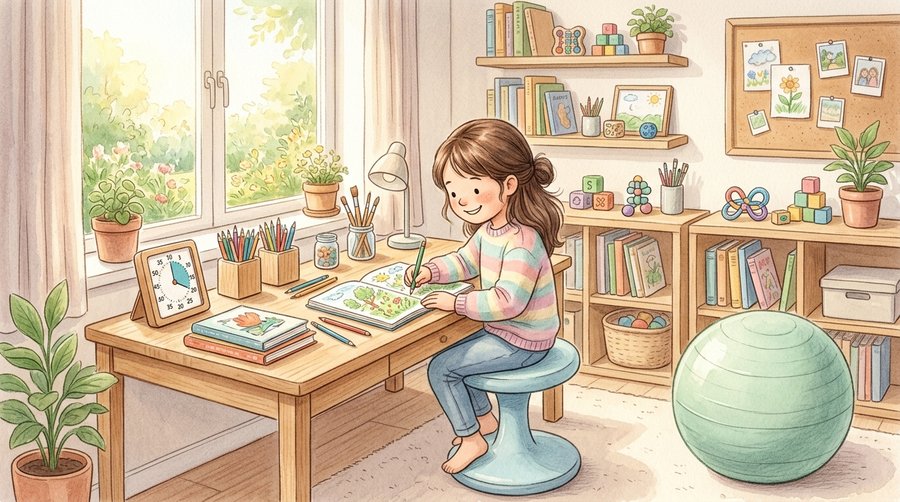
Tired of homework battles, chair tipping, and constant fidgeting? An architect dad and pediatric OT team review the 6 best active seating chairs, wobble stools, and balance ball seats for ADHD kids—plus the exact 90-90-90 sizing rule and 504 plan wording.
Editorial Disclosure & Medical Scope: Sensory Kids Books shares neurodiversity-affirming, lived-experience insights and sensory-informed tools for parents, caregivers, and educators. This publication is for educational purposes only and does not constitute formal medical diagnosis, psychiatric evaluation, or clinical occupational therapy advice. Always consult a qualified pediatrician or licensed clinician for individual medical care. As an Amazon Associate, we earn from qualifying purchases through our independent affiliate links at zero extra cost to you.
If your ADHD child rocks on the back legs of their chair, drapes their body upside down over the armrest, or abandons their homework desk every three minutes to pace the hallway, they are not being defiant—their brain is starving for motor stimulation. Traditional school chairs and dining room seats are designed for static, rigid compliance. But for a neurodivergent child whose prefrontal cortex relies on continuous vestibular and proprioceptive input to stay awake, sitting still literally triggers neurological fog.
As both an architect obsessed with physical ergonomics and a parent navigating the ADHD sensory journey, I partnered with pediatric occupational therapists to evaluate the most durable, crash-tested active seating options on the market. In this guide, we break down the 6 best active seating chairs, wobble stools, and sensory cushions—complete with weight capacities, safety ratings, exact 90-90-90 posture sizing charts, and legal wording to write active seating into your child’s school 504 plan.
At a Glance: Top 6 Active Seating Picks for ADHD Kids
Before we analyze joint torque, core biomechanics, and classroom dynamics, here is how our top-tested active seats compare at a glance:
Patented gently rounded anti-tip base lets kids rock 360° smoothly without tipping over. Supports up to 275 lbs. GREENGUARD Gold certified for zero VOC off-gassing.
shopping_cart👉 Check Current Price on Amazon (paid link)open_in_new
38cm anti-burst balance ball seated in a wheeled caster base with locking wheels and lumbar back support. Perfect for 45-minute homework and reading blocks.
shopping_cart👉 Check Current Price on Amazon (paid link)open_in_new
Pneumatic height adjustment from 18.5" to 28" accommodates rapid growth spurts and works with standard kitchen islands and standing desks. 250 lb capacity.
shopping_cart👉 Check Current Price on Amazon (paid link)open_in_new
45cm sensory therapy ball featuring 5 weighted peg feet that anchor the ball when not in use. Eliminates classroom rolling distractions completely.
shopping_cart👉 Check Current Price on Amazon (paid link)open_in_new
Heavy-duty rubber band with support pipes that installs onto front desk legs in 2 minutes. Lets kids kick, stretch, and bounce silently without moving their seat.
shopping_cart👉 Check Current Price on Amazon (paid link)open_in_new
Dual-sided sensory air disc (smooth side + tactile acupressure nubs) supporting 1,000 lbs. Instantly transforms hard wooden dining chairs or school desks on a budget.
shopping_cart👉 Check Current Price on Amazon (paid link)open_in_new
The Neurobiology of Fidgeting: Why ADHD Kids Must Move to Focus
For decades, classroom culture treated physical movement as the enemy of learning. Children were commanded to "sit up straight, fold your hands, and stay still." But modern neuroscience has completely dismantled this assumption. In landmark studies published in the Journal of Abnormal Child Psychology and Journal of Attention Disorders, researchers discovered that gross motor movement in children with ADHD is not random misbehavior—it is a compensatory biological reflex designed to sustain alertness in under-aroused prefrontal cortical circuits.
The ADHD brain has a baseline deficit in dopamine and norepinephrine transmission. When an ADHD child is forced into static seating, cognitive arousal drops below the threshold required for executive function, leading to daydreaming, executive dysfunction, or explosive frustration. However, when the child engages in proprioceptive micro-movement (subtle tilting of the pelvis, rocking of the core, or kicking against resistance), signals fire up through the vestibular apparatus and reticular activating system (RAS). This physical movement stimulates dopamine production naturally, allowing the child to stay focused on complex cognitive tasks like math drills and reading comprehension without fatiguing their willpower.
In-Depth Reviews: The 6 Best Active Seating Solutions of 2026
1. Kore Kids Wobble Stool (14" / 15.6") — Best Overall OT Wobble Stool
If you ask any pediatric occupational therapist to name the single most reliable active seating chair in their sensory clinic, nine out of ten will point to the Kore Kids Wobble Stool. Engineered and manufactured in the USA, this stool features a patented convex base that allows 360-degree continuous motion—tilting, swiveling, and swaying—while preventing the stool from sliding out from beneath the child.
• Why It Excels: The anti-tip geometry is mathematically brilliant. Traditional round-bottom stools often roll past their center of gravity, sending a child tumbling to the floor. Kore designed a patented safety ring around the base perimeter that acts as a physical mechanical stop at a 20-degree tilt angle. Your child can rock aggressively while finishing a worksheet without ever tipping over.
• Material & Safety: Crafted from recyclable, antimicrobial plastic with zero lead or phthalates. It is GREENGUARD Gold certified for low indoor chemical emissions and holds an impressive 275-pound static load capacity.
• Best For: Elementary and middle school kids (ages 4–11) who constantly rock back on their chair legs during dinner or homework.
Patented anti-tip base, 360° smooth continuous motion, 275 lb weight rating, GREENGUARD Gold certified.
shopping_cart👉 Check Current Price on Amazon (paid link)open_in_new
2. Gaiam Kids Balance Ball Chair with Backrest — Best for Homework Desks & Extended Study
While wobble stools offer fantastic freedom of movement, some children with low muscle tone (hypotonia) or severe postural fatigue experience back and neck strain after 20 minutes without support. The Gaiam Kids Balance Ball Chair with Backrest bridges this gap by combining the dynamic sensory feedback of an inflatable therapy ball with the structural comfort of an ergonomic office chair.
• Why It Excels: The chair features a 38cm anti-burst balance ball nestled inside a heavy-duty polypropylene frame with smooth-rolling caster wheels (with dual locks). It allows gentle vertical bouncing and pelvic tilts, but adds a low-profile lumbar support bar behind the child. When your child needs a micro-break from active core balancing, they can lean back without losing their seat.
• Setup Note: Follow the two-step inflation protocol: inflate the ball to 80% capacity on day one, allow the vinyl to stretch for 24 hours at room temperature, then top off to 100% inflation. This prevents the ball from bottoming out against the plastic frame.
• Best For: Kids ages 5–12 who spend 30 to 60 minutes seated for homework, virtual tutoring, or creative art projects.
38cm anti-burst therapy ball, rolling base with locks, ergonomic back support. Holds up to 175 lbs.
shopping_cart👉 Check Current Price on Amazon (paid link)open_in_new
3. Learniture Active Learning Curved Motion Stool (18"-23") — Best Adjustable Height for Tweens & Teens
One major complaint parents have about traditional wooden or fixed-height sensory stools is that kids outgrow them within 12 months. The Learniture Active Learning Curved Motion Stool eliminates this frustration with an integrated pneumatic gas-lift cylinder that adjusts smoothly from 18.5 inches up to 28 inches at the push of an under-seat lever.
• Why It Excels: As an architect, I appreciate the industrial build quality. The stool features a textured, non-marring thermoplastic rubber base that grips hardwood, tile, and commercial carpet with equal tenacity. The seat pad is upholstered with high-density polyurethane foam that doesn’t bottom out under heavier tweens and teens (up to 250 lbs capacity).
• Height Versatility: Because of its wide adjustment range, this stool transitions seamlessly between a standard 30-inch study desk, a 36-inch kitchen breakfast bar, and a sit-to-stand motorized desk.
• Best For: Upper elementary students, middle schoolers, and high school teens experiencing rapid growth spurts.
Pneumatic height adjustment from 18.5" to 28", non-slip rubberized curved base, thick foam seat, 250 lb capacity.
shopping_cart👉 Check Current Price on Amazon (paid link)open_in_new
4. Gaiam Kids Stay-N-Play Balance Ball with Feet — Best Value Classroom Yoga Ball (Will Not Roll Away)
If you’ve ever placed a standard fitness yoga ball in a classroom or playroom, you already know the disaster scenario: the moment your child stands up to get a pencil, the ball rolls across the room, knocking over a water bottle or distracting five other children. The Gaiam Kids Stay-N-Play Balance Ball solves this exact pain point with five built-in stabilizing peg feet.
• Why It Excels: When the child sits down, the peg feet compress flat under their body weight, allowing full 360-degree rotational hip movement and gentle vertical bouncing. But the millisecond they stand up, the small feet re-engage the floor, anchoring the ball exactly where it was left. It delivers all the clinical benefits of dynamic ball therapy without the logistical headache.
• Classroom Acceptance: Teachers adore this design. It takes up no extra floor space beyond a standard chair and stores easily under school desks when not in use.
• Best For: Preschool, kindergarten, and elementary classrooms (ages 5–8, up to 175 lbs) needing a budget-friendly sensory seating upgrade.
45cm burst-resistant therapy ball with 5 stabilizing peg feet. Keeps ball grounded when standing up.
shopping_cart👉 Check Current Price on Amazon (paid link)open_in_new
5. The Original Bouncy Bands for Student Desks — Best Silent Classroom Desk Foot Fidget (504 Favorite)
What if your child’s school refuses to allow a wobble stool or exercise ball in the classroom due to space constraints or district liability rules? Enter The Original Bouncy Bands for Desks—an ingenious, zero-footprint sensory tool created by elementary school guidance counselor and educator Scott Ertl.
• Why It Excels: Bouncy Bands slip over the two front legs of a standard individual student desk using patented molded support pipes. The heavy-duty, latex-free rubber band stretches across the opening, creating a silent trampoline for your child’s feet. Kids can push against the band, bounce their calves, hook their ankles, and release pent-up motor energy silently beneath their desk without drawing stares from peers.
• Academic Impact: Independent educational studies have shown that students using Bouncy Bands stay on-task an average of 10% longer (nearly 35 extra minutes per school day) and exhibit significantly reduced test anxiety during timed standardized exams.
• Best For: Children in Grades 1–8 who are constant foot-tappers, knee-bouncers, or desk-wanderers.
Heavy-duty rubber band with support pipes for desk legs 19"-24" apart. 100% silent motor outlet.
shopping_cart👉 Check Current Price on Amazon (paid link)open_in_new
6. Tumaz Extra-Thick Inflatable Wobble Cushion (13") — Best Portable Sensory Seat for Dinner & School
If you need a sensory seating solution that travels seamlessly between school, the kitchen dinner table, restaurants, and grandma’s house, the Tumaz Extra-Thick Inflatable Wobble Cushion is the ultimate high-portability, sub-$25 lifesaver.
• Why It Excels: Constructed from commercial-grade, anti-burst PVC tested up to an astonishing 1,000 lbs, this 13-inch disc sits directly on top of any standard rigid chair. It features dual textures: one smooth surface for gentle postural wobble, and one side covered in raised acupressure nubs that deliver rich tactile feedback through clothing. By adjusting the air pressure with the included needle pump, you can fine-tune the instability from subtle micro-movement to intense core engagement.
• Floor Meditation & Heavy Work: Beyond chair seating, kids can stand on the disc with both feet for balance training during brush-teeth routines, or kneel on it during puzzle time to recruit deep core stabilizers.
• Best For: Parents on a budget, families who travel frequently, and kids who struggle to stay seated through evening family dinners.
Dual-sided sensory disc supporting 1,000 lbs. Includes pump to customize firmness. Fits any standard chair.
shopping_cart👉 Check Current Price on Amazon (paid link)open_in_new
Comparison Table: Spec Breakdown for All 6 Active Seats
Comparison Table: Spec Breakdown for All 6 Active Seats
Side-by-side engineering specifications, weight capacities, and motion types to help you choose the best active chair for your child.
| Product | Motion Type | Weight Limit | Target Age | Best Use Case | Price | Action |
|---|---|---|---|---|---|---|
Kore Kids Wobble Stool (14"/15.6") Best Overall | 360° Tilt & Swivel | 275 lbs | Ages 4–11 | Primary homework desk & anti-tip stability | ~$69–$79 | shopping_cartCheck Price |
Gaiam Balance Ball Chair with Backrest Best for Study | Vertical Bounce & Sway | 175 lbs | Ages 5–12 | Extended 45-min study sessions with lumbar support | ~$79–$95 | shopping_cartCheck Price |
Learniture Curved Motion Stool Best Adjustable | Convex Rocking (18.5"–28") | 250 lbs | Ages 9–16+ | Standing desks, kitchen counters & growing tweens | ~$59–$75 | shopping_cartCheck Price |
Gaiam Stay-N-Play Balance Ball Classroom Pick | Multi-directional Bounce (Peg Feet) | 175 lbs | Ages 5–8 | Classrooms & carpet time (will not roll away) | ~$22–$28 | shopping_cartCheck Price |
The Original Bouncy Bands for Desks Silent Fidget | Heavy-Duty Elastic Bouncing | 100k+ Bounces | Ages 6–14 | Silent in-desk fidgeting (IEP & 504 favorite) | ~$16–$20 | shopping_cartCheck Price |
Tumaz Inflatable Wobble Cushion Best Portable | Dynamic Air Disc (Tactile Nubs) | 1,000 lbs | All Ages | Portable dining chair & travel on budget | ~$18–$24 | shopping_cartCheck Price |
The 90-90-90 Sizing Rule: How to Prevent Postural Fatigue
The number one mistake parents make when purchasing active seating is buying a stool that is too tall for their child. In pediatric occupational therapy, optimal ergonomic positioning follows the 90-90-90 rule:
1. Hips at 90 Degrees: The pelvis should be slightly tilted forward or level, with the torso upright.
2. Knees at 90 Degrees: The thigh should run parallel to the floor, forming a right angle at the knee joint.
3. Ankles at 90 Degrees (Feet Flat): Both feet MUST rest flat on the floor or a solid footrest. If your child’s feet are dangling, their pelvic stabilizers disengage, causing their lower back to hyper-extend and triggering muscle fatigue within 15 minutes.
How to Measure: Have your child sit on a flat surface with their feet flat on the floor and knees bent at 90 degrees. Measure the distance from the crease behind their knee (the popliteal fold) down to the floor. Match this measurement exactly to the stool seat height:
• Popliteal height 12"–13": Choose a 12-inch toddler/kindergarten stool.
• Popliteal height 14"–15": Choose the standard Kore 14-inch stool (Grades 1–3).
• Popliteal height 15"–17": Choose the Kore 15.6-inch or 16-inch stool (Grades 4–6).
• Popliteal height 18"+: Choose an adjustable stool like the Learniture (18.5"–28") or standard adult size.
How to Add Active Seating to Your Child’s School 504 Plan or IEP
Under Section 504 of the Rehabilitation Act of 1973 and IDEA, public school students with diagnosed ADHD, Sensory Processing Disorder, or Autism Spectrum Disorder are legally entitled to reasonable classroom accommodations that provide equal access to the curriculum. For our complete master checklist of enforceable clauses, see our comprehensive guide:
When requesting active seating during your 504 meeting, never simply say "my child needs a wobble stool." School administrators frequently reject vague requests as "unnecessary privileges." Instead, use this occupational-therapy-backed accommodation script:
"Accommodation: Student shall be provided access to an OT-approved active seating accommodation (e.g., Kore wobble stool, inflatable tactile wobble cushion, or desk-mounted resistance foot band) during all seated independent seatwork and direct instructional periods. Student shall not be penalized, scolded, or redirected for engaging in non-disruptive motor movement while remaining in their workspace."
Pairing Active Seating with Gross Motor Sensory Breaks
Active seating works wonders for sustaining attention during seated work, but it does not replace the need for high-intensity sensory decompression. If your child arrives home from school in a state of high neurological overload, active seating alone will not stop a meltdown. We strongly recommend pairing daytime active seating with an after-school sensory compression swing and a structured visual schedule.
👉 Explore our tested guide: The 7 Best Indoor Sensory Swings for Autism & ADHD Kids (With & Without Ceiling Mounts)
👉 Download our free printable: The Free Sensory Diet Template: How to Build a Low-Demand Daily Schedule
Final Verdict: Which Active Seat Should You Choose?
Here is our bottom-line recommendation based on your primary use-case and setup:
• For the Primary Homework Desk: Invest in the Kore Kids Wobble Stool ($69–$79). Its patented anti-tip curvature makes it the gold-standard indestructible tool for elementary ADHD focus.
• For Long 45+ Minute Study Blocks: Choose the Gaiam Kids Balance Ball Chair with Backrest ($79–$95) to combine active bouncing with vital lumbar postural support.
• For Strict Classrooms & Zero-Footprint Desks: Send your child with The Original Bouncy Bands for Desks ($16–$20) for 100% silent leg swinging.
• For Dinner Tables & Travel on a Budget: Grab the Tumaz Inflatable Wobble Cushion ($18–$24) to turn any hard dining chair into a sensory seat in two seconds.
 Instant PDF
The ADHD & PDA Anti-Planner
An Undated, Low-Demand Gamified Planner & Focus Journal for Neurodivergent Minds
Quick Answers for Parents & Educators
Recommended Sensory Products
Carefully curated products for a sensory-friendly environment.
Kore Kids Wobble Stool (14" / 15.6")
BEST OVERALL OT WOBBLE STOOL
Patented rounded anti-tip base enables gentle 360° continuous micro-movement without ever tipping over. Supports up to 275 lbs. GREENGUARD Gold certified for clean indoor air.
Gaiam Kids Balance Ball Chair with Backrest
BEST FOR HOMEWORK DESKS & EXTENDED STUDY
Combines a 38cm anti-burst therapy ball with a locking caster base and ergonomic lumbar back support. Keeps posture upright while channeling excess motor restlessness.
Learniture Active Learning Curved Motion Stool (18"-23")
BEST ADJUSTABLE HEIGHT FOR OLDER KIDS & TWEENS
Pneumatic gas lift cylinder allows effortless height adjustment from 18.5" to 28". Thick foam padded seat with non-slip rubberized curved base. Heavy-duty 250 lb capacity.
Gaiam Kids Stay-N-Play Balance Ball with Feet
BEST VALUE CLASSROOM YOGA BALL (WILL NOT ROLL AWAY)
45cm burst-resistant sensory ball with 5 built-in stabilizing peg feet that keep the ball anchored when your child stands up. Solves the rolling classroom ball problem.
The Original Bouncy Bands for Student Desks
BEST SILENT CLASSROOM DESK FOOT FIDGET (504 FAVORITE)
Heavy-duty latex-free rubber band with patented molded support pipes that slip over standard school desk legs. Lets kids kick, bounce, and stretch their legs silently.
Tumaz Extra-Thick Inflatable Wobble Cushion (13")
BEST PORTABLE SENSORY SEAT FOR DINNER & SCHOOL
Dual-sided sensory disc (one smooth, one acupressure nubbed) with 1,000 lb anti-burst PVC. Instantly turns any hard dining chair or plastic school desk into an active seat.
📚 Evidence-Based Sources & Citations
Peer-reviewed literature, clinical frameworks, and foundational neurodiversity resources referenced in this guide.
- Gross Motor Activity Facilitates Working Memory in Children with ADHD: A Kinematic Evaluation — Journal of Attention Disorders & American Psychological Association(2016)View Sourceopen_in_new
- Effects of Alternative Seating on Classroom Behavior and In-Seat Task Engagement in Children with ADHD — American Journal of Occupational Therapy (AJOT)(2019)View Sourceopen_in_new
- Vestibular Stimulation and Prefrontal Cortex Oxygenation: Neural Mechanisms of Motion-Induced Attention — Frontiers in Integrative Neuroscience(2022)View Sourceopen_in_new
- Ergonomic Guidelines for Educational Furniture & Active Seating Mechanics — U.S. Consumer Product Safety Commission (CPSC) & ANSI/BIFMA(2024)View Sourceopen_in_new
Join the Conversation
Get our monthly guide on sensory-aware parenting and neuro-inclusive home design delivered straight to your sanctuary.
Respecting your inbox and your peace of mind.
Leave a Reply
Your email address will not be published. Required fields are marked *